"At times our own light goes out and is rekindled by a spark from another person. Each one of us has cause to think with deep gratitude of those who have lighted the flame within us."
~ Albert Schweitzer (1875-1965), Nobel Laureate
Sunday, September 9, 2012
Thursday, September 6, 2012
Here we go again...
Getting an MRI on both hips. Hope to rule out osteonecrosis after increasing pain in pelvis and hip joints. Unfortunately, this is so common with Cushing's :/


Friday, August 31, 2012
"Glucocorticoids and Mood"
Another wonderful article from our friends at the Cushing's Support & Research Foundation (www.csrf.net) for this article. It is so important to understand the emotional as well as the physical toll that Cushing's plays.
Click here to read CSRF's article entitled Glucocorticoids and Mood
| |


| Glucocorticoids and Mood |
| By Dr. Jennifer Kirkland, Ph.D On June 20- 21, 2008, I had the rare opportunity to attend the conference Glucocorticoids and Mood: Clinical Manifestations, Risk Factors and Molecular Mechanisms. Sponsored jointly by UC San Diego Department of Psychiatry and The Diana Foundation, this conference came about in part, in response to the death of Diana Padelford Binkley. In 2003, after getting high dose steroids for a herniated disc, Diana suffered the side effect of steroid psychosis and subsequently committed suicide. Since glucocorticoids are used in managing many diseases, the 20% rate of psychiatric impairment found in those getting high dose treatment shows the need for better understanding of the risks and impact on patients. A call for the most recent findings brought researchers from around the world together to unravel the mysteries underlying this phenomenon and to come up with answers to lessen risks on patients. Given that cortisol and its synthetic partner cortisone are used so widely, the impact of high cortisol on mood and memory was highlighted. Since excess cortisol is the cause of Cushing's related symptoms, patients with Cushing's were studied. As many who have had Cushing's already guessed, high rates of mood and memory problems were found. Two-thirds (66%) to 100% of those studied had symptoms ranging from anxiety (66%), impaired concentration (66%), night awakenings (69%), decreased sex drive (74%), impaired memory 83%, irritability (86%), decreased energy (97%), fatigue (100%). High cortisol was found to actually shrink the hippocampus brain region, which related directly to verbal memory problems in Cushing's patients. Luckily, when the high cortisol state is reversed, the brain region goes back to normal size, and memory problems are largely reversed. And with treatment, over time, mood and psychiatric symptoms returned to levels found in those without Cushing's. What a relief to hear in a scientific conference that we aren't crazy, but having Cushing's can make us that way temporarily! The implications of such difficulties have raised awareness of the risks of giving high dose steroids. The types of treatments that tend to trigger mood problems and steroid psychosis were presented. They found that single high dose administrations of corticosteroids can cause temporary irritability, restlessness or memory problems. However, when the treatment is prolonged, steroid psychosis can happen. Studies vary on the rate this happens, but the range is 1.3% to a whopping 57%, making the average across studies 6%. The disturbing part to this finding is that no one knows why one person may have no symptoms and another may commit suicide. Thus, researchers urged that the risk be communicated with a "black box" warning by pharmaceutical companies. The one upside to this problem is that a whole new area of treating psychiatric disorders with cortisol lowering drugs has evolved. Although largely experimental, in some cases, lowering cortisol with mifepristone had a therapeutic effect similar to standard antidepressants making it a potentially good alternative when standard treatment can not be given. The second half of the conference was basic research that studied glucocorticoids on the molecular level. Glucocorticoids (cortisol) exert their effects on individual cells in the body by binding to a protein called a glucocorticoid receptor. Although still in the experimental stages, such research is paving the way for exciting developments. The first of such was the finding that glucocorticoid receptors (GR) can behave differently not just among people but even within a person. Thus, depending on the tissue type, the GR can respond in a highly sensitive or even an immune way. This variability in the action of GR may explain why Cushing's can appear so different in the way it presents clinically. Some people may or may not get the same symptoms in part due to how the GRs respond at the cellular level. Once again, we are finding that Cushing's has many faces, and can not be diagnosed on the basis of having a specific set of symptoms. Researchers have also expanded on the finding that glucocorticoids are the "first-responders" when the body is stressed. The body sends out a red flag that there is a problem by showing markers of inflammation. Glucocorticoids respond by moving in to reduce the inflammation. When studying mood disorders such as depression, a link between having an exaggerated inflammatory response to stress was linked with both depression and illness. Thus, when an individual has a GR that is resistant to this red flag of inflammation, more inflammation occurs. This lack of response is implicated in both cancer risk and depression. Perhaps the most exciting part of this half of the conference was how researchers are working to improve treatments based on basic research findings. Because different GRs behave differently, finding drugs that change behavior at the receptor level could increase the quality of many people's lives. Right now, pharmaceutical researchers are working on this issue in developing a glucocorticoid that does not cause osteoporosis. Thus, for those thousands of people who are on long term, higher dose corticosteroid treatment, within a few years, the new drug could greatly reduce the risk of osteoporosis! Another promising finding will help the many people who suffer with chronically high cortisol levels because of anxiety or depression. The challenge in treating it has been to lower cortisol without completely shutting it down. Even though chronically high cortisol has unpleasant effects, losing the body's ability to respond to stress can be life threatening. Trials of the drug mifepristone have demonstrated that the drug can lower cortisol effects without shutting it down. Thus, those who have chronically high cortisol can get relief without the danger of losing this response that is necessary during stress completely. The final panel discussion revealed that, despite having the best and the brightest researchers in the world present, we were left with more questions than answers. Obviously, the research presented is scratching the surface in finding solutions to complex problems such as Cushing's. But the best part for me though, was to see how the awareness of Cushing's as both a clinical syndrome and model for study has spread worldwide. I was able to look around at the treatment providers in the audience, and say "yeah, I think they get it" when it comes to a compassionate understanding of how devastating Cushing's can be. That was the best realization of all. Editor's Note: Jennifer Kirkland is a clinical neuropsychologist in private practice in the San Francisco Bay Area, California. Dr. Kirkland has the unique combination of years of psychological experience as well as personal experience with Cushing's, which makes her extremely qualified to report on the psychological impact of glucocorticoids.. She counts her two greatest accomplishments as completing her Ph.D. while being diagnosed and treated for adrenal Cushing's and having a baby on 11/30/07. |
Tuesday, August 28, 2012
Solu-Cortef Alert
Thank you to our friends at www.caresfoundation.org for this important reminder. As you know, many Cushies rely on Solu-Cortef in cases of adrenal insufficiency. Solu-Cortef is for Cushies what Glucagon is for Type I diabetics. It is life-saving.
From: CARES Foundation <brendan@caresfoundation.org>
| |||||||||||||||||


Sunday, August 26, 2012
Hip pain coupled with shoulder pain
Crutches in Cushing's disease
Avascular necrosis of bone can be almost silent until it comes under unusual strain. We report a case in point and lessons learned.
Hip Pain: Another Cushing's Symptom
Cushing's Disease Presenting with Avascular Necrosis of the Hip: An Orthopedic Emergency
ABSTRACT
Nontraumatic avascular necrosis (AVN) of the hip is commonly caused by exogenous glucocorticoid administration, whereas it has rarely been associated with endogenous hypercortisolism. We report a 30-yr-old woman with Cushing's disease whose presenting manifestation was early AVN of the hip. Although plain x-ray was negative, magnetic resonance imaging (MRI) of the hip showed stage 2 AVN. Her orthopedic disease was considered an emergency, and thus, it was treated with core decompression before the diagnosis of Cushing's syndrome (CS) was pursued further. The femur recovered fully, as demonstrated by her improved clinical picture and a subsequent MRI. AVN carries a poor prognosis, if not treated early. The diagnostic procedure of choice is MRI, because plain radiographs are falsely negative in early stages. This case illustrates that AVN can be the presenting manifestation of CS; to prevent irreversible effects on the femoral head, core decompression should not be delayed for the purpose of evaluation and treatment of CS.Read article in full here:
Yup, Your Ticker Could Go, Too!!
Cushing's Patients Must Be Screened for Heart Disease
By Piriya Mahendra, MedWire Reporter
Published August 12, 2012
Individuals who use glucocorticoids and exhibit iatrogenic Cushing's syndrome should be "aggressively" targeted for early screening of cardiovascular (CV) risk factors, say researchers.
Laurence Fardet (University College London, UK) and colleagues found that individuals with iatrogenic Cushing's syndrome who were prescribed glucocorticoids had a significantly higher incidence of CV events (including coronary heart disease, heart failure, or ischemic cerebrovascular events) than individuals prescribed glucocorticoids without iatrogenic Cushing's syndrome, or those not prescribed glucocorticoids.
Indeed, Cushing's syndrome patients prescribed glucocorticoids had a CV incidence rate per 100 person-years at risk of 15.1 compared with 6.4 and 4.1 in those without Cushing's but who were prescribed glucocorticoids and those not prescribed glucocorticoids, respectively.
Multivariate analysis revealed that iatrogenic Cushing's patients had a 2.27-fold increased risk for coronary heart disease, a 3.77-fold increased risk for heart failure, and a 2.23-fold increased risk for ischemic cerebrovascular events.
Compared with individuals prescribed glucocorticoids without iatrogenic Cushing's syndrome, those with Cushing's and glucocorticoids had a 2.74-fold increased risk for CV events.
Cushing's patients prescribed glucocorticoids also had a 4.16 higher risk for CV events than individuals not prescribed glucocorticoids.
"These results raise the question of whether glucocorticoids increase the risk of CV events in all patients or only in those who develop iatrogenic Cushing's syndrome," remark the authors.
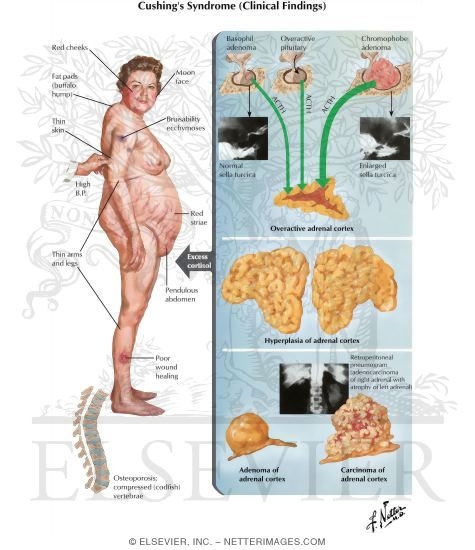
Iatrogenic Cushing's syndrome is characterized by a cushingoid adiposity, with hypertrophy of adipose tissue in the face (giving the appearance of a "moon face"), dorsocervical region ("buffalo hump," double chin), and abdomen, and thinning of the subcutaneous adipose tissue of the limbs.
The authors say that a glucocorticoid-induced cushingoid appearance must no longer be considered as a minor adverse event of glucocorticoid treatment and point out that it has been associated with some features of the metabolic syndrome.
"It is therefore essential that patients prescribed glucocorticoids who develop iatrogenic Cushing's syndrome are assessed for CV risk and monitored regularly in both primary care and secondary care for early prevention of CV disease," they conclude in the British Medical Journal.
Licensed from Medwire news with permission from Springer Healthcare Ltd. ©Springer Healthcare Ltd.
All rights reserved. Neither of these parties endorse or recommend any commercial products, services, or equipment.
Thursday, August 16, 2012
In Loving Memory: Kym Grupido
Thank you to Boise Glow for Cushing's Awareness for sharing Kym's story as part of their continued efforts to draw attention to this terrible disease.
My heart breaks for Kym, her family, and all those who knew and loved her.
For more about Kym's life and battle with Cushing's, click to read her sister's loving account.
Editor's Note: While the Cushing's Support & Research Foundation (csrf.net) would like to print only positive stories, many Cushing's stories are very sad. Kym's story illustrates that even with all our current technology and diagnostics, more awareness is desperately needed. We hope Kym's story tugs at your heartstrings and will perhaps motivate you to share your own story in a local paper, if you have not done so already. If Kym's family and doctors had been aware of Cushing's, there is a good chance Kym would not have died. It is for this reason the CSRF feels strongly that her story needed to be shared.
For more about Kym's life and battle with Cushing's, click to read her sister's loving account.
Editor's Note: While the Cushing's Support & Research Foundation (csrf.net) would like to print only positive stories, many Cushing's stories are very sad. Kym's story illustrates that even with all our current technology and diagnostics, more awareness is desperately needed. We hope Kym's story tugs at your heartstrings and will perhaps motivate you to share your own story in a local paper, if you have not done so already. If Kym's family and doctors had been aware of Cushing's, there is a good chance Kym would not have died. It is for this reason the CSRF feels strongly that her story needed to be shared.
 |
| Click to enlarge. |
Wednesday, August 15, 2012

Wednesday, August 1, 2012
Pituitary Patient Sues for Misdiagnosis
Pituitary tumors are not as rare as people think. Studies of autopsy reports show that up to 20% of the population -- one in five people -- have a pituitary tumor. However, doctors continue to dismiss patents with acromegaly and Cushing's, causing years of sickness and despair. One can only hope this court ruling prompts a few MDs study up on pituitary disorders.

| – | Why Is Early Diagnosis Such A Problem?
The confusing constellation of symptoms that can be produced by pituitary tumors and the difficult to visualize location make diagnosis very tricky. It is not uncommon for patients to have symptoms of either hormonal deficiency (caused by compression of the pituitary or its "stalk") or hormone excess (caused by unregulated production of hormones by the pituitary tumor). In a significant minority of patients diagnosis is not made until the individual has developed debilitating or life-threatening symptoms of heart disease or adrenal (uncommon), gonadal and/or thyroid insufficiency. Even in the 21st century death from a large pituitary tumor or hormonal deficiency still occurs, albeit rarely. Early diagnosis is usually a reflection of a high index of suspicion on the part of a physician. Unfortunately, many doctors have been taught that pituitary disease is rare, so it is not at the forefront of their list of possible diagnoses.
|
| – | How Prevalent Are Pituitary Tumors/Disease?
Autopsy reports and radiologic and MRI evidence from around the globe indicate that one out of every five people worldwide has a pituitary tumor. The earliest study took place in 1936, when Dr. R.T. Costello of the Mayo Foundation conducted a cadaver study and found pituitary tumors in 22.4 % of the population (Costello R.T. Subclinical adenoma of the pituitary gland. Am. J. Pathol. 1936; 12:205-214). Statistics have not changed much ever since. The clinical significance of these findings are critical to determine.
|
| – | Why Are These Tumors So Common?
We don't know because funding for benign brain tumor research is virtually nonexistent. That's about to change. In October 2002, Congress passed the Benign Brain Tumor Cancer Registries Amendment Act, which will force hospitals, clinics and doctors to report pituitary tumor incidence rates in the data collection of cancer registries. The problem remains diagnosis. No report of incidence rates is possible without it.
|
| – | Why Aren't Pituitary Tumors/Disease Common Knowledge?
There are four main reasons:
|
Saturday, July 28, 2012
Boom & Bust: Stress Fuels Market Crisis

To that end, I am thrilled to share this article, "Boom & Bust: Stress fuels market crisis." This article provides fascinatingly detailed look at the roles stress and cortisol played during the financial crisis. Cortisol is cited for changing the bodies and personalities of risk-seeking stockbrokers as they faced an uncertain market future.
The author even names cortisol "the molecule of irrational pessimism."
I hope you will take a few moments to read this article, and please understand that the changes these brokers faced during the crisis are the same struggles we Cushing's patients face every day, for years and years. While I am not asking for empathy for stockbrokers, per se, I am asking you to read this article with Cushies in place of the stockbrokers. Reading about their symptoms may help you see your Cushie in a new way. If it does, hold her or him a little tighter, and admit you learned something about this illness. Your stock is sure to rise, as it will be music to your loved one's ears.
Click through to the original article on the Montreal Gazette.
Saturday, July 21, 2012
Boise Glow for Cushing's Awareness
Our friends at Boise Glow for Cushing's Awareness are doing an awesome job creating awareness for Cushing's in their corner of the world. In particularly, I love this nighttime activity. Cushing's is a "disease of the night," and runaway cortisol keeps us awake. Learn more at http://www.facebook.com/BoiseGlow
 |
| Click to enlarge photo. |
Thursday, July 19, 2012
Another Doctor Appointment Goes South
Thanks to a fellow Cushie for making this. It is important to show friends and family how dismissive doctors are towards Cushies, often not even letting us make our point and immediately telling us we are "doing it wrong."
You can see another patient's version here.
Wednesday, July 18, 2012
Gambling on a Cushing's Diagnosis: What are the Odds?
A
Cushing’s friend of mine recently asked what we can say to our doctors to
explain why we think we have Cushing’s. The Cushing’s community knows
that the burden of proof falls on our shoulders to prove we have Cushing’s to a
doctor, before tests are run and even after positive tests confirm it. These doctors play judge and we Cushing’s
patients must prove beyond a reasonable doubt that we have Cushing’s, often in
the hostile setting of doctor’s office after doctor’s office. Seems harsh?
Seems unfair?
Doctors are taught in medical school that they are unlikely to see a case of
Cushing’s in their entire medical careers. In fact, doctors admit that Cushing's may be the most difficult diagnosis to make in all of medicine. Sigh. So we walk in, prepared as our Cushie friends
have recommended and armed with symptoms
list, photo summary, and past lab results. Doctors are still incredibly
dismissive and cruel. They blame the patient for their weight gain, regardless
of exercise or dietary habits. They routinely dismiss all points the patient
makes. Many doctors eagerly counter
every point and spout facts that are incorrect according to published medical
literature.
So what
are we supposed to do? Give up? No.
We keep fighting no matter what.
To that
end, I wanted to share the argument I have used for a long time on several
occasions. In fact, I just used this during my appointment with a new neurosurgeon this past Friday.
*******
In statistics, we learn the concept of probability. Probability is the chance that something will happen - how likely it is that some event will happen. With each variable added, we decrease the probability that each one of those things can occur together at the same time.
Think of the elusive, rare Cushing's diagnosis as a slot machine with 7 wheels. Each wheel is labeled with nice fruit images and contains one of the following:
· all Cushing's symptoms
· high urine cortisol
· high ACTH
· positive IPSS
· MRI showing pituitary tumor
Now spin
the wheel. For a Cushing’s diagnosis, each wheel must land on
the diagnostic criteria for Cushing’s listed above.
What is
the likelihood that all of those things are going to "hit" and line
up for the jackpot?
It is
not probable. In fact, the odds are stacked against you to have all those
things line up like they do. For us Cushing's patients, THEY DO LINE UP. WE DO
HAVE ALL THOSE THINGS CONFIRMING CUSHING'S. It is a RARE occurrence, and it
doesn't happen often, but people do spin the wheels on a slot machine and line
up all the wheels to win. For us, of course, Cushing's is a HUGE loss -- no win
at all.
Now,
let’s take a gander at what the diagnosing slot machine would have to look like
for me to get my Cushing’s diagnosis, since my doctors require multiple high
test results in each of the testing categories.
 |
| To confirm my Cushing's diagnosis, it would take 28 slot machines with 5 wheels and all 140 wheels landing on Cushing's. Guess what? They did. Lucky me. |
· many Cushing's symptoms (75 wheels for each of my Cushing's symptoms)
· high
urine cortisol (25 wheels for each test)
· high ACTH (4 wheels for each test)
· positive IPSS (1 wheel)
· multiple MRIs showing
pituitary tumor (3 wheels)
Now
then, based on my lab values in each category, for my diagnosis, we have built
a slot machine with 140 wheels. Think of how much space this would take up in a Vegas casino!).
So, let’s imagine me going up to have a seat.
So, let’s imagine me going up to have a seat.
I pull
the arm.
I spin
the wheel.
One by
one, each wheel lands on the picture showing CUSHING’S.
My Cushing’s diagnosis is confirmed. It is rare, but it is not impossible. Yet, doctors still argue and berate the patient. You can see why I have very little tolerance for someone who calls my diagnosis, or any Cushie’s diagnosis, into question. It is ludicrous, unfathomable, and unconscionable for any medical professional to doubt us, due to their ignorance, pre-conceived notions, lack of medical curiosity, or their tight schedule that prevents them from listening to us and really understanding our whole history. The way doctors treat Cushing’s patients should be illegal.
My first neurosurgeon told me that in medical school, doctors are taught to find the one disease that explains everything and to not accept many "little" diagnoses strung together. It was imperative to find the diagnosis that captures as many of the symptoms as possible. I implore the medical community to remember that lesson and do more to help their patients.
There is no doubt why we Cushing’s patients are the determined lot we are. We know our own bodies. It is our unrelenting pursuit for the truth, our unwillingness to give up on ourselves, and our ability to learn about our disease from those who face its challenges every day that enable us to fit all the puzzle-piece-diagnoses together in search for our cure.
That's
why I look at *all* of my friends as Cushie
warriors.
Friday, July 6, 2012
"Pituitary Disorders, the Often Missed Diagnosis"
"Pituitary Disorder: the Often Missed Diagnosis"
Dr. Lewis Blevins is the medical director of the California Center for Pituitary Disorders at UCSF Medical Center. In this interview, he discusses the trickiest gland in the body. The transcript and audio are posted on their patient education page.
Thursday, July 5, 2012
Less Fat, Still Weak after Cushing's
Good news.
Fat decreases after wild, errant cortisol overproduction from Cushing's is stopped. Just like we Cushies told everyone it would. See, it's not just from over-eating and not exercising.
Bad news.
Muscle weakness persists. Cardiovascular risk associated with unfair fat symptom may remain. So do cognitive issues.
Shoot. This disease just won't let up.
* * * * * * * * * * * * * * * * * * * *
Body composition and cardiovascular risk markers after remission of Cushing's disease: a prospective study using whole-body MRI
J Clin Endocrinol Metab. 2012 May;97(5):1702-11. Epub 2012 Mar 14.
Source
Department of Medicine, Division of Endocrinology, Mount Sinai School of Medicine, One Gustave Levy Place, Box 1055, New York, New York 10029, USA. eliza.geer@mssm.edu
Abstract
CONTEXT:
Cushing's Disease (CD) alters fat distribution, muscle mass, adipokine profile, and cardiovascular risk factors. It is not known whether remission entirely reverses these changes.
OBJECTIVES:
Our objective was to determine whether the adverse body composition and cardiovascular risk profile in CD change after remission.
DESIGN, SETTING, AND PATIENTS:
Fourteen CD patients were studied prospectively: before surgery (active disease) and again postoperatively 6 months after discontinuing oral glucocorticoids (remission). Whole-body magnetic resonance imaging was used to examine lean and fat tissue distributions.
OUTCOME MEASURES:
Body composition (skeletal muscle and fat in the visceral, bone marrow, sc, and inter-muscular compartments) and cardiovascular risk factors (serum insulin, glucose, leptin, high-molecular-weight adiponectin, C-reactive protein, and lipid profile) were measured in active CD and remission (mean 20 months after surgery).
RESULTS:
Remission decreased visceral, pelvic bone marrow, sc (including trunk and limb sc), and total fat; waist circumference; and weight (P < 0.05). Remission altered fat distribution, resulting in decreased visceral/total fat (P = 0.04) and visceral fat/skeletal muscle ratios (P = 0.006). Remission decreased the absolute muscle mass (P = 0.015). Cardiovascular risk factors changed: insulin resistance, leptin, and total cholesterol decreased (P < 0.05), but adiponectin, C-reactive protein, and other lipid measures did not change.
CONCLUSIONS:
CD remission reduced nearly all fat depots and reverted fat to a distribution more consistent with favorable cardiovascular risk but decreased skeletal muscle. Remission improved some but not all cardiovascular risk markers. Remission from CD dramatically improves body composition abnormalities but may still be associated with persistent cardiovascular risk.
* * * *
Thanks to MaryO for the post.
Wednesday, July 4, 2012
A Cushie's Job: Trudging through the Medical Literature
If you have spent any amount of time on this blog, you will know that I am patient advocate who encourages you to be the most informed and self-aware patient you can be. For us Cushies, especially us cyclical Cushing's patients, it is imperative to be up-to-date on the medical literature.
You also know how difficult that task can be as we fight to keep our energy up for basic daily tasks and chores. You also remember how Cushing's causes cognitive impairments that just don't give us the right state of mind -- clarity or positivity -- to take on a project this big.
You also know how difficult that task can be as we fight to keep our energy up for basic daily tasks and chores. You also remember how Cushing's causes cognitive impairments that just don't give us the right state of mind -- clarity or positivity -- to take on a project this big.
So, I decided to just post stuff here, as I find it. It may be a repeat (sorry, I probably forgot), or it may be new. Regardless, it will be stuff I am stumbling through as I relearn everything I have to know about Cushing's in order to make my decision.
I am reading through the medical literature for articles like Long-term remission rates after pituitary surgery for Cushing’s disease: the need for long-term surveillance posted by our dear Cushie friend Robin at Survive The Journey. I am also trying to wade a list of articles my friend Susan recommended about cyclical Cushing's posted on PubMed, the government's database. These free articles include research done with your tax dollars at the National Institute of Health (NIH). The NIH is considered an authority on Cushing's and even cyclical Cushing's. Based on what I have seen in my five years, the NIH seem to specialize in pediatric Cushing's cases more than adults, i.e. I see more pediatric patients than adult patients accepted for testing and treatment at the NIH.
So, I have to make my way through the medical literature about:
I am reading through the medical literature for articles like Long-term remission rates after pituitary surgery for Cushing’s disease: the need for long-term surveillance posted by our dear Cushie friend Robin at Survive The Journey. I am also trying to wade a list of articles my friend Susan recommended about cyclical Cushing's posted on PubMed, the government's database. These free articles include research done with your tax dollars at the National Institute of Health (NIH). The NIH is considered an authority on Cushing's and even cyclical Cushing's. Based on what I have seen in my five years, the NIH seem to specialize in pediatric Cushing's cases more than adults, i.e. I see more pediatric patients than adult patients accepted for testing and treatment at the NIH.
So, I have to make my way through the medical literature about:
- quality of life for patients after several pituitary surgeries vs. quality of life for those who chose BLA
- remission rates for each type of treatment (3rd pituitary surgery vs BLA)
- enzymes and other hormones produced in the pituitary that may vanish after repeated pituitary surgery
- patient success stories for each
I mean, all this and a bag of chips. EVERYTHING! I read a lot of this stuff in the beginning. It was "this could happen to me" reading, so the shock resonated longer than the information. Meaning, the scariness stuck when the facts didn't.
Now, I find my mind so hazy that I just can't read through these medically-rigorous articles anymore. I really struggle.
I can't remember what I read already.
I can't find something I already found before.
I can't even think of good keywords to search.
I've already made a million laps around the internet.
It's a mess. I AM A MESS!
So, being that it is my blog, this is what I'm gonna do. I plan to "store" articles here that I am reviewing for my own benefit. If you see something that you have never seen before, well, you benefit, too.
I can't remember what I read already.
I can't find something I already found before.
I can't even think of good keywords to search.
I've already made a million laps around the internet.
It's a mess. I AM A MESS!
So, being that it is my blog, this is what I'm gonna do. I plan to "store" articles here that I am reviewing for my own benefit. If you see something that you have never seen before, well, you benefit, too.
HEY! THEN MAYBE YOU CAN MAKE MY DECISION FOR ME!
Tuesday, July 3, 2012
A Truncated Life or A Path with Purpose
With all this time today online on a laptop (instead of my iPhone), I stumbled onto my post announcing here that the second pituitary surgery FAILED on May 16, 2011. That's over a year ago. That was 413 days of my life, gone, can't get back, because of Cushing's. That's 1 year, 1 month, 16 days of not feeling well, not having answers, and not being myself.
When I see that in writing - always more real than living it, somehow - I get teary-eyed.
So many days of suffering.
When I see that in writing - always more real than living it, somehow - I get teary-eyed.
So many days of suffering.
So many days of heart ache.
So much loss of life.
Yes. I mean that.
Loss of life.
It may not be many in terms of number of people. I concede that.
It may not be many in terms of number of people. I concede that.
In terms of quality of life, it is unquantifiable.
Cushing's has done irreparable damage, and that makes me hard to forgive it. My husband and toddler suffer collateral damage. Cushing's places countless limitations on me cognitively, emotionally, and physically that my family sees, just as I live my daily life. They don't get to live a full life with me if Cushing's won't allow me to live my full life.
In terms of the every day and big-dream things Cushing's keeps me from doing, boy, the damage is really immeasurable. I feel the loss of my soul. I miss my identity. Not that I ever really knew who I WAS was. Seriously. But I did know what I liked to do, did them, and loved doing them. So if I am not what I do, but who I am, then Who am I now?
My friend Ashley concurred. She said, "I feel that way, too. I feel Cushing's has silenced me... like I was on the verge of something really good, and then Cushing's came along and said, "Shut up. No one can hear you now."
Word, Ashley. SILENCED. That is so it. I feel that way, too. I feel like the trajectory of my life has forever been altered by this disease. I hate that part. It really makes me angry.
I think back to when I was a young girl. I felt average. Not better, not worse than others. Definitely not more special. However, I always felt, for some reason, that I was gonna do something BIG, something great. I don't remember (sadly) anyone really telling me that, so I don't know where it came from. I didn't have any talent to pinpoint, so that wasn't it, unless quoting scenes from 80s movies is a talent. My family didn't have talent shoes I could step in (sorry family, if you are even reading this). Regardless of its origin, this feeling really is something that I just carry around with me. Any second, any day, I am thinking this purpose will pop out like clowns in a circus car.
My life will make sense, and I will have found my purpose.
I don't know yet what that purpose is, but I feel sure that my something great has not happened yet. I am also unsure if Cushing's will hinder that greatness or amplify it. I hope, beyond hope, it is the latter. And more than ever, I hope this purpose presents itself sooner rather than later. I don't know how much longer I can hold on.
Cushing's has done irreparable damage, and that makes me hard to forgive it. My husband and toddler suffer collateral damage. Cushing's places countless limitations on me cognitively, emotionally, and physically that my family sees, just as I live my daily life. They don't get to live a full life with me if Cushing's won't allow me to live my full life.
In terms of the every day and big-dream things Cushing's keeps me from doing, boy, the damage is really immeasurable. I feel the loss of my soul. I miss my identity. Not that I ever really knew who I WAS was. Seriously. But I did know what I liked to do, did them, and loved doing them. So if I am not what I do, but who I am, then Who am I now?
My friend Ashley concurred. She said, "I feel that way, too. I feel Cushing's has silenced me... like I was on the verge of something really good, and then Cushing's came along and said, "Shut up. No one can hear you now."
Word, Ashley. SILENCED. That is so it. I feel that way, too. I feel like the trajectory of my life has forever been altered by this disease. I hate that part. It really makes me angry.
I think back to when I was a young girl. I felt average. Not better, not worse than others. Definitely not more special. However, I always felt, for some reason, that I was gonna do something BIG, something great. I don't remember (sadly) anyone really telling me that, so I don't know where it came from. I didn't have any talent to pinpoint, so that wasn't it, unless quoting scenes from 80s movies is a talent. My family didn't have talent shoes I could step in (sorry family, if you are even reading this). Regardless of its origin, this feeling really is something that I just carry around with me. Any second, any day, I am thinking this purpose will pop out like clowns in a circus car.
My life will make sense, and I will have found my purpose.
I don't know yet what that purpose is, but I feel sure that my something great has not happened yet. I am also unsure if Cushing's will hinder that greatness or amplify it. I hope, beyond hope, it is the latter. And more than ever, I hope this purpose presents itself sooner rather than later. I don't know how much longer I can hold on.
Monday, July 2, 2012
I Hate You, Cushing's Disease
Hi everyone. Sorry for such a long absence. In this past, I take time off from writing when I myself am too sick to talk about Cushing's. When I am exhausted all the days, riddled with headaches, body aches, dizziness, and muscle spasms, I don't feel like the best public speaker for Cushing's. Nor do I have the energy to queue up posts to show up in my absence. Nope. I was too sick for all that.
 I still have Cushing's disease.
When will it ever end?!
High cortisol and high ACTH.
GO AWAY.
This absence, like other times, is caused by my own testing, diagnosis, and clearance for third pituitary surgery. That's right. You read that right.
I still have high cortisol at diagnostic levels on four different diagnostic tests.
I have a third tumor showing on my pituitary that did not show itself last year at surgery.
I am still fighting Cushing's.
I hate Cushing's.
When will it ever end?!
High cortisol and high ACTH.
GO AWAY.
Things get really complicated when you are this far into a Cushing's diagnosis. The likelihood of a positive outcome decreases with each stage of treatment. There aren't a lot of people in this world "like you," and even fewer that you may have access to. Nope, for sure, these tiny details make the next decision even more difficult on the patient.
And frankly, when can I cry UNCLE?
When can I say that I've had enough of this beast called Cushing's?
When will this be over?!
I am considering next steps for treatment: third pituitary surgery vs. bilateral adrenalectomy with risk of developing Nelson's syndrome from an untreated pituitary tumor vs. medical therapy such as Korlym. Each has its risks and benefits. Which risk is greatest? Which benefit is greatest? Well, it seems everyone has a different opinion on that.
And frankly, when can I cry UNCLE?
When can I say that I've had enough of this beast called Cushing's?
When will this be over?!
I am considering next steps for treatment: third pituitary surgery vs. bilateral adrenalectomy with risk of developing Nelson's syndrome from an untreated pituitary tumor vs. medical therapy such as Korlym. Each has its risks and benefits. Which risk is greatest? Which benefit is greatest? Well, it seems everyone has a different opinion on that.
I fear that the effort to make this decision will exceed the energy I have in a day. I spent the first 72 hours after learning of the presence of a third pituitary tumor in a tailspin. First, notify the family. Second, notify my Cushies, my besties. Third, reach out to neurosurgeons for second, third, and fourth opinions. Fourth, reach out to Cushies who have been *here,* who have made this decision, and see if they can tell me something I don't know, something I've forgotten, something I just can't know until I've lived it. Fifth, look around the rest of my life, and do some things that need completing. Things that are super important to me, like completing the redecorating of my preschooler's room. Watch out world, a Cushie's got things to do!
My main concern now is wondering how I will make the right decision. How will I know what to do? Somehow the right path for me will present itself. Right?
I am keeping my eyes open for all the signs, asking for help from everyone I can, including friends I rely on and can trust.
I participate in my own healthcare. I am an advocate because this is my life, my body. No one knows it better than me, and I know me best. I've never left me behind. I've never failed to show up. I haven't missed any important events. I have, however, been too busy to listen to myself. I have placed other opinions before my own. I have muted my instincts to appease someone else.
In this situation, after all that has happened to me, after all I have faced, I just can't let that happen. I will know the right answer when it feels right *to me.* So, isn't that my answer? If I can keep my aim right there, right in that small spot of people to please, I hope to hit the bulls eye. As long as I can live with my decision, I'll know I made the right one. When that happens or what it will be, I do not know. Stay tuned as I share information I'm sorting through as I make my decision.
My main concern now is wondering how I will make the right decision. How will I know what to do? Somehow the right path for me will present itself. Right?
I am keeping my eyes open for all the signs, asking for help from everyone I can, including friends I rely on and can trust.
I participate in my own healthcare. I am an advocate because this is my life, my body. No one knows it better than me, and I know me best. I've never left me behind. I've never failed to show up. I haven't missed any important events. I have, however, been too busy to listen to myself. I have placed other opinions before my own. I have muted my instincts to appease someone else.
In this situation, after all that has happened to me, after all I have faced, I just can't let that happen. I will know the right answer when it feels right *to me.* So, isn't that my answer? If I can keep my aim right there, right in that small spot of people to please, I hope to hit the bulls eye. As long as I can live with my decision, I'll know I made the right one. When that happens or what it will be, I do not know. Stay tuned as I share information I'm sorting through as I make my decision.
Friday, June 1, 2012
"It is Literally Impossible for You to Have Cushing's"
As much as these patient-made videos cause me to cheer, I am quickly infuriated at how endocrinologists get away with dismissing patients who come to them for help. I have had many of these types of appointments. Even though I calmly fight and stand my ground, like the female patient in this video, I continue to get dismissed... even with my surgical history and past test results. It is frankly disgusting.
Thursday, May 31, 2012
Tuesday, May 29, 2012
Subscribe to:
Posts (Atom)