Showing posts with label self diagnosis. Show all posts

Tuesday, December 2, 2014

My Story with Truth and Honesty

I love family and I enjoy genealogy. Recently, I found a cousin Dorotea in another country on Facebook. Seeing a post, she asked, are u sick?

Well, what do I say? That is a long and complicated answer. I have been sick for decades. How do retell that long story? How much does she want to know? How much should I drop in the lap of an unsuspecting cousin?

Right that moment, I began to tap out a reply on my iPhone. I just wrote and wrote. I guess you tell your story by just spitting it all out. You just tell the whole thing -- without shame, without embarrassment. To know me is to know the story of my life. It is long and complicated but it is important. I am important. Sick or well, I am important.

I don't want sympathy. I don't need pity.

I only want compassion that is given freely to any other human. What about the ones you love as friends or family?! I only want the compassion that I give to be returned. I don't like Cushing's. I hate it, in fact. However, I know I love my life with true intentions. I give compassion more freely now that I have lived this life. I want people to not be afraid of me and to stop avoiding me because they don't understand my disease or my life now. For those reasons, I told my story with truth and honesty.

------

I had two tumors on a part of my brain called the pituitary. It hangs below the brain and controls all hormones or chemicals in the body. It is called the master gland. Well, I was very sick for at least a decade and didn't know why. In April 2007, I found the disease Cushing's on the computer. I read and read. I cried. Instantly, I knew I had this disease. So for the next seven years, I have been testing for diagnosis and re-diagnosis to convince the doctors and surgeons I indeed had this super rare disease where the pituitary hormone ACTH works with the hormone cortisol from the adrenal gland to respond to stress in a loop. We know now that Cushing's is not as rare but rarely diagnosed. I had my first pituitary brain surgery in June 2009. The neurosurgeon went through my nose to the center of my head where the pituitary sits. The tumor was removed but I kept producing the hormone cortisol in excess, and that hurt all my organs and kept me very sick. I tested again. I sought help from a Cushing's specialist in Los Angeles, CA after many friends online finally got help from him. My second pituitary brain surgery was in April 2011. Again, tumor and extra cells under the pituitary were removed, but I still felt sick and was not cured. I tested again to confirm cortisol excess in my body. Indeed, I still had Cushing's and my results kept getting higher each time I tested. In August 2012, I tried a medication ketoconazole to lower my cortisol. That did the job but it pushed the cortisol I needed to live every day too low, and I was bedridden and could not wake up during the day. I had to take Ritalin or a stimulant in the am in order to counter the effects of lowering my cortisol at night which left me little cortisol to get through the day. It was a daily struggle to take care of myself and my small child at home. Cooking, cleaning, and self care were impossible. I used every bit of energy to care for my child and I had little left to do anything else. I struggled with this every day until October 2013. I had enough. The Food & Drug Administration (FDA) put limitations on long-term use of Ketoconazole due to the prevalence of liver damage. The drug had already been outlawed in the European Union. I waited as long as I could but I couldn't wait any longer. Cortisol was destroying my life and my body. I began testing for excess cortisol in early November 2013, and my cortisol levels in urine, blood and saliva were the highest I had ever had and definitely proved that my body was flooded with cortisol. It was time to end cortisol production once and for all. On New Years Eve 2013, I had a bilateral adrenalectomy or BLA, the removal of both adrenal glands that produce cortisol. While this fixed my Cushing's disease, it gave me Addison's disease. I don't produce excess cortisol. Now I produce no cortisol. The body needs cortisol! You make it and don't even know about it! I will take medication daily for the rest of my life to replace the hormones not made by my damaged pituitary gland. I take medication to replace the hormones my adrenal glands make. If I forget these adrenal medications, I could die within 24 hours. The body must have cortisol to function. I must take my meds daily and at the same times. I have struggled hourly and daily to find the right amount of medication that matches my body's needs. I get blood tests often to check my hormone levels. It has been very difficult for me, my husband, and my young daughter, and even my parents who come from out of state to help when they can by staying a few weeks to a month to help my family with the daily things I can no longer do because of the damage that Cushing's and high cortisol has done. Then and now, I suffer from muscle weakness all over my body, bone pain, back pain, extreme fatigue, osteopenia, anxiety, depression and other mental disturbances, insomnia, and other things I can't even remember I suffer from because my brain is always foggy.

What I know for sure is that I am a fighter. I will continue to fight for myself and my family who supports me daily with hugs, love, and laughs. I am an advocate to help people get diagnosis and treatment sooner. I have maintained a blog since 2008 at http://cushingsmoxie.blogspot.com because back in those days, an internet search for Cushing's produced more results for dogs and horses than humans. Well, the blog is a success with over 600,000 hits total. Many patients have contacted me through the years, and we have gotten them to diagnosis and surgical treatment. I speak to hundreds of patients a week to answer questions about testing, surgery, and surviving a life and body flooded with cortisol. They learn from me and I learn from them. This disease is very complex, very nuanced. The story is different but the damage is the same. As patients, we take care of one another. We provide a safety net where none existed before. We are ill but united. As I move forward every day, I know I am doing my best. I take a set amount of cortisol and aldosterone replacement daily. If I get stressed, my body uses up that set amount and my body has no cortisol to run basic body functions. Therefore, I avoid stress at every turn. I don't watch the news. I stay away from people who bring me down. I am fighting to fill my life with more joy and less junk. I'm looking for a sort of bliss that comes after years of being in bed, not being myself, not doing what I wanted to do. My thoughts and actions focus only on that: BLISS.

Wednesday, July 18, 2012

Gambling on a Cushing's Diagnosis: What are the Odds?

A Cushing’s friend of mine recently asked what we can say to our doctors to explain why we think we have Cushing’s. The Cushing’s community knows that the burden of proof falls on our shoulders to prove we have Cushing’s to a doctor, before tests are run and even after positive tests confirm it.  These doctors play judge and we Cushing’s patients must prove beyond a reasonable doubt that we have Cushing’s, often in the hostile setting of doctor’s office after doctor’s office. Seems harsh? Seems unfair?

Doctors are taught in medical school that they are unlikely to see a case of Cushing’s in their entire medical careers.  In fact, doctors admit that Cushing's may be the most difficult diagnosis to make in all of medicine. Sigh. So we walk in, prepared as our Cushie friends have recommended and armed with symptoms list, photo summary, and past lab results. Doctors are still incredibly dismissive and cruel. They blame the patient for their weight gain, regardless of exercise or dietary habits. They routinely dismiss all points the patient makes.  Many doctors eagerly counter every point and spout facts that are incorrect according to published medical literature.

So what are we supposed to do? Give up? No. We keep fighting no matter what.

To that end, I wanted to share the argument I have used for a long time on several occasions. In fact, I just used this during my appointment with a new neurosurgeon this past Friday.

*******

In statistics, we learn the concept of
probability. Probability is the chance that something will happen - how likely it is that some event will happen.  With each variable added, we decrease the probability that each one of those things can occur together at the same time. 

Think of the elusive, rare Cushing's diagnosis as a slot machine with 7 wheels. Each wheel is labeled with nice fruit images and contains one of the following: 

·       all Cushing's symptoms
·       high urine cortisol
·       high saliva cortisol
·       high ACTH
·       positive IPSS
·       MRI showing pituitary tumor

Now spin the wheel.  For a Cushing’s diagnosis, each wheel must land on the diagnostic criteria for Cushing’s listed above.

What is the likelihood that all of those things are going to "hit" and line up for the jackpot?
It is not probable. In fact, the odds are stacked against you to have all those things line up like they do. For us Cushing's patients, THEY DO LINE UP. WE DO HAVE ALL THOSE THINGS CONFIRMING CUSHING'S. It is a RARE occurrence, and it doesn't happen often, but people do spin the wheels on a slot machine and line up all the wheels to win. For us, of course, Cushing's is a HUGE loss -- no win at all.

Now, let’s take a gander at what the diagnosing slot machine would have to look like for me to get my Cushing’s diagnosis, since my doctors require multiple high test results in each of the testing categories.
To confirm my Cushing's diagnosis, it would take
28 slot machines with 5 wheels and all 140 wheels
landing on 
Cushing's. Guess what? They did. Lucky me.

·       many Cushing's symptoms (75 wheels for each of my Cushing's symptoms)
·       high urine cortisol (25 wheels for each test)
·       high midnight cortisol serum (25 wheels for each test)
·       high saliva cortisol (7 wheels for each test)
·       high ACTH (4 wheels for each test)
·       positive IPSS (1 wheel)
·       multiple MRIs showing pituitary tumor (3 wheels)

Now then, based on my lab values in each category, for my diagnosis, we have built a slot machine with 140 wheels. Think of how much space this would take up in a Vegas casino!). 

So, let’s imagine me going up to have a seat. 
I pull the arm.
I spin the wheel.

One by one, each wheel lands on the picture showing CUSHING’S.

My Cushing’s diagnosis is confirmed. It is rare, but it is not impossible. Yet, doctors still argue and berate the patient.  You can see why I have very little tolerance for someone who calls my diagnosis, or any Cushie’s diagnosis, into question. It is ludicrous, unfathomable, and unconscionable for any medical professional to doubt us, due to their ignorance, pre-conceived notions, lack of medical curiosity, or their tight schedule that prevents them from listening to us and really understanding our whole history. The way doctors treat Cushing’s patients should be illegal.

My first neurosurgeon told me that in medical school, doctors are taught to find the one disease that explains everything and to not accept many "little" diagnoses strung together. It was imperative to find the diagnosis that captures as many of the symptoms as possible.  I implore the medical community to remember that lesson and do more to help their patients.

There is no doubt why we Cushing’s patients are the determined lot we are. We know our own bodies. It is our unrelenting pursuit for the truth, our unwillingness to give up on ourselves, and our ability to learn about our disease from those who face its challenges every day that enable us to fit all the puzzle-piece-diagnoses together in search for our cure. 
That's why I look at *all* of my friends as Cushie warriors.

Monday, April 30, 2012

Day 28: The Buffalo Hump


In the five years since I first learned of Cushing's, I have noticed many discussions among Cushies about their buffalo hump.  Folks just discovering Cushing's are particularly fixated with this discovery.

Who ever knew that an innocent deposit of fat could be a cause of such scorn, concern and distress?

I wrote about my self-guided path to diagnosis back in 2008. Today, I realized I haven't mentioned much about the buffalo hump since that post.  I now realize I have been remiss in not giving the buffalo hump the exposure it necessitates. The people want to know!

The buffalo hump -- listed among other many Cushing's symptoms -- was my a-ha symptom.

Excerpted from the post describing my self-guided path to diagnosis:

Not only did I experience nearly all of the symptoms on the list, I knew when I read the words "buffalo hump" that this was it. I just knew this is what I had.

Here is the buffalo hump picture I saw on the internet:


www.cushings-help.com


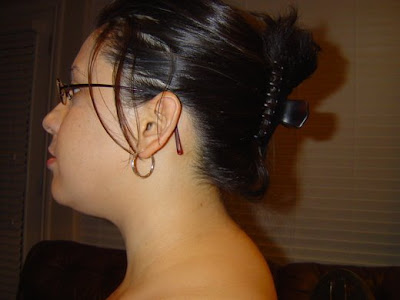
Here is my buffalo hump.
www.cushings-help.com
Copyright. Cushing's with Moxie. No reproduction without sourcing.


Copyright. Cushing's with Moxie.
No reproduction without sourcin

I searched the internet to see what else could cause a buffalo hump.
  • Cushing's (overproduction of cortisol caused by tumors in the pituitary or adrenal glands)
  • Long term use of steroids (when persons with normal cortisol production regularly take synthetic cortisol such as prednisone as medication to relieve the symptoms caused by another illness)
  • Pituitary tumor (could be source of Cushing's)
  • Hyperinsulinaemia (could be part of symptomology of Cushing's)
  • Morbid obesity (not on its own, usually part of the symptomology of Cushing's)
  • HIV and AIDS medications
  • Kyphosis (this is so easy to distinguish from a buffalo hump that I can't believe it made this list.  Kyphosis affects vertebrae between the shoulder blades and mid back, while a buffalo hump begins four inches below the hairline along the neck where the tops of the right shoulder and left shoulder meet in the middle.
    You can see kyphosis diagrams here and here.)
    NOTE: I measured my buffalo hump this way: hold up your right hand and tuck away your thumb. Place your four fingers sideways on your neck, with your pinkie touching the bottom of your hairline.  My index finger touches the top of my buffalo hump.
I looked up all the unfamiliar terms, and I knew they didn't apply. It could only be Cushing's.

My hump and me on a good day. We have a roller coaster relationship.Copyright. Cushing's with Moxie. No reproduction without sourcing.
So, to give my buffalo hump the credit it is due, I will share what I have learned about them over the years.

Q:  Is this a really a buffalo hump?
A:  If a person is asking about a buffalo hump, it is usually a buffalo hump.  Small or large, it is a hump. Accept this odd symptom especially when a patient has many other symptoms of Cushing's.

Q:  My doc says my hump is from obesity, but it looks like humps from diagnosed Cushies.
A:  Your doctor probably means well, but s/he hasn't seen as many Cushies as we have in the online community. In the past 60 months studying Cushing's and seeing my Cushie friends as real-time case studies, I have seen hundreds of patients think they have Cushing's, get knocked around in the diagnosis phase, only to have biochemically proven Cushing's with multiple tests (urine, saliva, blood) and/or ACTH-stained pathology from tumor(s) removed in pituitary surgery.
Also, see questions above.

Q:  My hump hurts. Does yours?
A:  Yes, mine kills me! My buffalo hump pulls at my neck making it hard to hold upright some days. I have spent hundreds of visits over the past 15 years at multiple chiropractors always looking for relief from the buffalo hump pain.  It never goes away, but sometimes I get relief for a few days.  Oh, how much money I must have spent in copays at the chiropractor!

I missed many days of work because this thing.  I would wake up and couldn't move my neck.  I couldn't lift my head off the pillow and would have to roll over onto my stomach to then push myself up off the bed just to get myself upright. It was not pretty.

Even today, I experience so much pain from this thing.  I feel a tension running from my neck down my right shoulder and no amount of heat/ ice combinations or stretching will ameliorate the pain. Typically, I have to take pain medication and lie down in order for relief to find me.

Also, my buffalo hump gets hard and soft!  It is so strange!  When the hump feels hard, it is usually causing me some pain.  When it is softer, sometimes I can press down and feel like I am not pressing on bone. It feels looser or softer.  I remember teling a Cushing's specialist about this, and he said, "I hear that all the time, but we don't know what causes the pain in a fatty hump or what makes it go up or down." Hmmphh. Neither do the patients!

Q:  Will it go away after pituitary surgery or when I am cured?
A:  Unknown.  Some say yes, some say no.  My presumption is to make sure your cortisol normalizes before really thinking you are gonna see any change.  That may take years after surgery (-ies).

Q:  My doc says it's a dowagers hump. My mom says it is poor posture. Could this thing really be a buffalo hump?
A:  They are wrong. A buffalo hump and kyphosis bump are located in different places on the spine. See discussion on kyphosis above the photo.  Also, when I take my side profile photos, I stand up super tall, shoulders back, head straight up as if a string is pulling my head up through the ceiling. Guess what? I still have a hump. It is not poor posture.

Q:  What do you do to hide your buffalo hump?
A.  To be honest, I don't hide my hump.  I can hardly drag myself out of bed or make it to the shower daily.  I have to focus on the big stuff, and for me, vanity flew out the window about 100 pounds ago.
However, I have seen others concerned about camouflaging their humps. Some wear their hair long to cover it, while others never wear a ponytail.  Some only wear collared clothes and never collarless clothes.  Again, for me, I can't be bothered by that thing!  Perhaps it helps that I can't see it every day, so really, I kinda forget about it.  Since you really can't do much about yours until your Cushing's is cured, I suggest you just forget it is back there, too. :)

~ * ~ * ~ * ~ * ~ * ~ * ~ * ~ * ~ * ~ * 


I saw this photo comparison for the first time this week. You can also see fat in the patient's neck and cheeks.

~ * ~ * ~ * ~ * ~ * ~ * ~ * ~ * ~ * ~ * 

Yes, this is a real place!  
Buffalo Hump Lake is located in south central Wyoming.