Hi everyone. I am working on a few blog posts that I hope I can post soon. For today, I'd like to spend a minute or two helping some new folks figure out what to do next. I know I've got a lot of information on this site. Sometimes, you need the basics. Here are the basics. I hope it helps.
HIGH UFCS
A high urinary free cortisol test, or UFC, is the "gold" standard of Cushing's tests. That means, if your UFC value is high, it is likely you have Cushing's. Doctors of all disciplines don't know much about Cushing's, but they seem to remember one fact about Cushing's: you have to have a high UFC to have it.
Now, if you do not have a high UFC, you could still have Cushing's. I took over 15 UFC tests and I never had an abnormal UFC. Never. I was told by eight endocrinologists that I did not have Cushing's. In fact, many patients will never have a high UFC, but many are later diagnosed with cyclical Cushing's. They--and I--still have Cushing's.
The important thing to remember is that hypercortisolism, or the overproduction of cortisol, can be measured in a few different tests. No one tests excludes the diagnosis of Cushing's. However, abnormal test after abnormal tests, in conjuction with multiple symptoms, does point to Cushing's.
midnight cortisol saliva
8 am cortisol serum blood test
4 pm cortisol serum blood test
midnight cortisol serum blood test
24-hour urine free cortisol test (UFC)High ACTH is indicative of hypercortisolism, since ACTH is the pituitary hormone that triggers the adrenals to produce cortisol.
8 am ACTH plasma blood test
4 pm ACTH plasma blood test
midnight ACTH plasma blood testGet a good understanding of Cushing's, ACTH, and cortisol, according to links on
Labtestsonline.org. Be sure to click on all five tabs above each entry:
ACTH (adrenocorticotropic hormone)cortisolCushing's 1 Cushing's 2 Cushing's 3From labtestsonline.org:
Is there anything else I should know?
How is it used?
ACTH levels in the blood are measured to help detect, diagnose, and monitor conditions associated with excessive or deficient cortisol in the body. These conditions include:
* Cushing’s disease: excess cortisol that is due to an ACTH-producing tumor in the pituitary gland (usually a benign tumor)
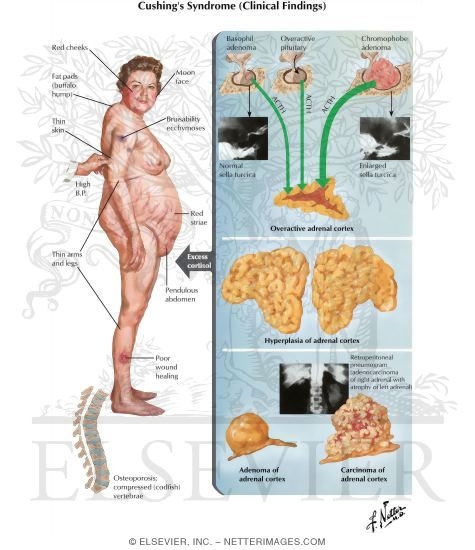
* Cushing's syndrome: refers to the symptoms and signs associated with excess exposure to cortisol. In addition to Cushing’s disease, Cushing’s syndrome may be due to an adrenal tumor, adrenal hyperplasia, the use of steroid medications, or due to an ACTH-producing tumor that is located outside the pituitary (such as in the lungs).
* Addison's disease, primary adrenal insufficiency: decreased cortisol production due to adrenal gland damage
* Secondary adrenal insufficiency: decreased cortisol production because of pituitary dysfunction
* Hypotituitarism: pituitary dysfunction or damage that leads to decreased (or no) hormone production by the pituitary – including ACTH production
Measuring both ACTH and cortisol can help to differentiate among some of these conditions. Because the level of ACTH normally changes in the opposite direction to the level of cortisol, your doctor can learn much by identifying an imbalance in this relationship and the direction in which the imbalance occurs. The table below indicates the common patterns of ACTH and cortisol seen with different diseases involving the adrenal and pituitary glands.
Cushing's disease (pituitary tumor making ACTH)High Cortisol
High ACTH
Adrenal tumorHigh Cortisol
Low ACTH
"Ectopic" ACTH (ACTH made by a tumor outside the pituitary, usually in the lungHigh Cortisol
High ACTH
Addison's disease (adrenal damage)Low Cortisol
High ACTH
HypopituitarismLow Cortisol
Low ACTH
OTHER HORMONESThe pituitary is the master gland. It controls every hormone produced in the body. The presence of a pituitary tumor will press on cells it shouldn't press on up there, causing the malfunction of other pituitary hormones. Therefore, if you are to test if the pituitary is affected by a benign tumor or microadenoma, it is important to test other hormone levels.
Oregon Health and Science University's Pituitary Unit: The Basic Pituitary Disease / Pituitary Tumor Work-up and
A Clinician's Guide to the Work-up of Pituitary DisordersHere are a few other sites that discuss the testing process. You will find that many repeat the same info. That is good. This repetition gives you the sense that there is an agreed protocal on how to diagnose this disease. Again, getting a high UFC is most of the battle. Once you have a high UFC test in your pocket, you can pretty much get doctors to order the other tests without much hassle, or so I've been told.
Cushing's Support & Research Foundation's Fact Sheet and
Cushing's Support & Research Foundation's Diagnostic Testing for Cushing's SyndromePituitary Network Association's Cushing's page.
This is a little more complicated reading from a medical journal, but again, I think you can work your way through it:
The Diagnosis of
Cushing’s Syndrome: An Endocrine Society Clinical Practice GuidelinePNA Disorders Section - Introduction to the Pituitary Gland
Categories:
Our thanks to Daniel Kelly, M.D. (Director, Neuro-Endocrine Tumor Center - John Wayne Cancer Institute at Saint’s John Health Center, Santa Monica, CA) and Pejman Cohan, M.D. (Director, Specialized Endocrine Care Center - Beverly Hills, CA) for providing the following disorder information.
Introduction To The Pituitary Gland
The pituitary is a small, bean-shaped gland located below the brain in the skull base, in an area called the pituitary fossa or sella turcica. The gland is regulated by a region of the brain called the hypothalamus and they are connected by a thin delicate vascular connection called the pituitary stalk or infundibulum. Weighing less than one gram and measuring a centimeter in width, the pituitary gland is often called the "master gland" since it controls the secretion of the body’s hormones. These substances when released by the pituitary into the blood stream have a dramatic and broad range of effects on growth and development, sexuality and reproductive function, metabolism, the response to stress and overall quality of life. The pituitary gland is thus at the anatomical and functional crossroads of the brain, mind and body.
Structurally, the pituitary gland is divided into a larger anterior region (adenohypophysis) and a smaller posterior region (neurohypophysis). Directly above the pituitary gland are the crossing fibers of the optic nerves called the optic chiasm as well as the optic nerves as they project to the eyes. On each side of the pituitary gland is the cavernous sinus which is a venous channel through which runs the large carotid arteries that carry blood to the brain, and important nerves that control eye movements and facial sensation. Because of the close proximity of the pituitary gland to these major intracranial nerves and blood vessels, as well as the vital hormonal control the pituitary gland provides, disorders of the pituitary can cause a wide spectrum of symptoms, both hormonal and neurological.
Listed below are the specific hormones produced by the pituitary:
Growth Hormone (GH): This is the principal hormone that, among many other functions, regulates body and brain development, bone maturation, metabolism and is essential for healthy muscles.
Luteinizing Hormone (LH) and Follicle Stimulating Hormone (FSH): These hormones control the production of sex hormones (estrogen and testosterone) as well as sperm and egg maturation and release.
Prolactin (PRL): This hormone stimulates secretion of breast milk.
Thyroid Stimulating Hormone (TSH): This hormone stimulates the thyroid gland to release thyroid hormones. Thyroid hormones control basal metabolic rate and play an important role in growth and maturation. Thyroid hormones affect almost every organ in the body.
Adrenocorticotropic Hormone (ACTH): This hormone triggers the adrenal glands (located above the kidneys) to release the hormone cortisol which in turn, regulates carbohydrate, fat, and protein metabolism and is essential in the stress response.
Vasopressin - Also called anti-diuretic hormone (ADH): This hormone promotes water to be reabsorbed by the kidneys and is thus essential in water and electrolyte balance.
In disease states, the pituitary gland may under- or over-produce hormones. Decreased or absent hormone production from the pituitary gland is called hypopituitarism (Pituitary Failure). The symptoms and treatments for pituitary failure are listed below:
Hormone
Deficient Symptoms
Treatment
Growth Hormone
Children: Growth delay
Adults: Decreased muscle mass, increased body fat, elevated cholesterol, low bone density (osteoporosis), impaired psychological well-being, poor quality of life Recombinant Human Growth Hormone- Given once daily as an injection under the skin
LH / FSH
Decreased libido, erectile dysfunction, irregular or absent menses, decreased body hair, decreased muscle strength, hot flashes, mood changes
Men: Testosterone- Given as either topical gel or patch or injections
Women: Estrogen + Progesterone-Given as either topical patch or pills
ACTH
Poor appetite, nausea, weakness, vomiting, low blood sugar, low blood pressure, dizziness, body aches Hydrocortisone or Prednisone-Given as daily pills
TSH
Fatigue, weakness, cold intolerance, dry skin, constipation, heavy/painful menses, weight gain, memory loss, mood disturbance
Levothyroxine – Given as daily pills (some examples include Synthroid or Levoxyl or Levothroid or Armour Thyroid)
Prolactin
Inability to lactate
No treatment available
Vasopressin (ADH)
Increased thirst and frequent urination
DDAVP- Given either as daily pills or nasal spray
Pituitary tumors (also called pituitary adenomas) can result in hormonal overproduction causing serious endocrine disturbances such as acromegaly (excess GH), Cushing’s disease (excess ACTH) or prolactinoma (excess prolactin). Other pituitary adenomas are non-functional or "endocrine-inactive," meaning that they do not produce excess hormones. Instead, as these tumors enlarge, they can cause compression of the normal pituitary gland leading to decreased or absent hormone production (hypopituitarism or pituitary failure), visual loss from optic chiasm or optic nerve compression and headaches. Pituitary failure may also result from bleeding into a pituitary tumor, pituitary or intracranial surgery, radiation therapy to the pituitary or head trauma. Other tumors that arise near the pituitary gland which can also impact pituitary hormonal function include Rathke’s cleft cysts, craniopharyngiomas, meningiomas, chordomas, gliomas and epidermoid cysts.
For more quick info, check out the info posted on the left side bar.
I hope this helps.
Cushie Melissa