Showing posts with label adrenal crisis. Show all posts

Tuesday, February 18, 2020

article: 2013 v. 2017 adrenal crises

A retrospective analysis of adrenal crisis in steroid-dependent patients: causes, frequency and outcomes

2019 article

Although we seem to be aware that extra precautions need to be taken to avoid adrenal crisis during trips and emotional stress, the truth is that most patients are AT HOME when AC occurs.

Sunday, April 29, 2018

Tips for the ER #1


April is Cushing's Awareness Month.
We Cushies have to go to the emergency room when we face adrenal insufficiency and adrenal crisis. I'll post some additional links (here), (here), and (here).

Tip #1: Stay focused on what you need
Dehydration, infections, and the inability to keep down oral cortisol replacement cause Cushies to take the dreaded drive to an emergency room. So before you get there, psyche yourself up on the ride over. You better mean business, or you won't get the help you need if you don't push for it.

When checking into the ER, I present my instructions from Adrenal Insufficiency United that states I should not be triaged. When the nurse tells me to sit down and she will be right with me, I refuse to go sit down. I ask that those instructions be reviewed by the charge nurse or ER medical director, and that I will there at the desk until nurse returns. This usually gets me taken back as the next person.

Wednesday, October 25, 2017

Adrenal Crisis & BLA

Take a listen to JenS as she describes her Cushing's journey and adrenal crisis.

*Thank you to MaryO, founder of www.cushings-help.org, for creating this series of podcasts.

Wednesday, September 6, 2017

Houston woman, post op Cushie dies during Hurricane Harvey

Wife, Mother of 2, post op Cushing's patient dies without medical care during Hurricane Harvey's flooding


Photos featured in Houston Chronicle article, 9/5/2017

UPDATE (10/17/2018). The New York Times released this story recently about Casey's death after her adrenalectomy on the one year anniversary of Houston getting hit by Hurricane Harvey. It is gut-wrenching. I cried the whole time I read it. Casey should be here with us. Her death was preventable.
As post op Cushies, we have to ask ourselves: Are we prepared for all of life's unexpected emergencies? Do we have plenty of cortisol replacement, hydration drinks, Solu-Cortef vials and syringes?

Right now, we have to BLA sisters Michelle and Kelly are fighting to stay healthy after Hurricane Michael absolutely obliterated their communities near Panama City Beach, FL. They are living without water and electricity, in the Florida heat, as patients who are steroid dependent. They are struggling but they were prepared with extra medicine.

When we tell you that you must be prepared in an emergency, we mean it. We don't want to lose you. Please promise us that you will take care of yourselves.

Originally published on 9/6/2017
.

I'll spare you waiting for the end of the article where it is mentioned and tell you now.

"Casey Dailey also was fighting Cushing's disease, a pituitary gland disorder often caused by a tumor creating excess cortisol. She had surgery Aug. 23 and went home the next day. Over the following weekend, she began feeling sick. She vomited, sometimes with blood. Then, she couldn't stand or talk, relatives said. A high fever started Sunday, after floodwaters surrounded her home, and she became unresponsive."


********

I have deep regrets that I never had a chance to know Casey and help her, a fellow Houstonian.  My heart just breaks because she never got the chance to get well and to be herself again. Every Cushie dreams of that.

We Cushies send our most heartfelt prayers to everyone who knew and loved Casey. 

I direct this to all the Cushies who may read this page. The gofundme page mentions Casey died from a post surgery infection. While this seems unrelated to Cushing's, it most certainly is. Infections absolutely and unequivocally lower cortisol. In fact, the body uses cortisol to fight infections. Left without antibiotics and more cortisol, any post op Cushies could die from adrenal crisis. Hurricane Harvey and flooding kept our poor Casey from getting the help she needed. I am calling it adrenal crisis. I am confident that many other seasoned Cushies will see Casey's situation and symptoms and conclude the same. What will prevent you from getting the emergency injection you need? A stubborn endocrinologist who refuses to give you one because you will also be close to the hospital? We've heard many say that.  Will it be a traffic jam, being alone when crisis symptoms prevent you from calling for help? We Cushies just never know.

I want to encourage all Cushies to contribute to the fund set up for Casey's family. Every dollar counts. Please mark yourself as a Cushie when you donate. I want the family to see how the Cushing's community steps forward and helps another Cushie's family. I know I am like every Cushie when I say this. I fear every day that this will happen to me. If you share that fear, please contribute even $5, and share this page. Tell others who love you that this could have been you. Ask them to donate, too. Please.

https://www.gofundme.com/dillsdaileyfund

Here is Casey's mother-in-law initial entry on the gofundme page:

My name is Darlene and I am writing this on behalf of my son Wayne Dailey. On August 29, 2017 Wayne tragically lost his wife Casey as a result of the devastating flooding in Houston, TX caused by Hurricane Harvey - shattering their and our lives forever.


Casey was home recovering from major surgery (adrenalectomy) just before the storm and ensuing flooding occurred when she became very ill due to post surgery infection and needed immediate medical attention.  We worked fervidly to contact all the emergency rescue organizations to try to get Casey evacuated to emergency medical services. After trying somewhere between 24-48 hours to get rescuers to the family we went to social media pleading for help. We were finally able to get volunteers to try and reach them. 

Wayne carried their two young sons, Luke and Ronnie, across the street in chest high water to Casey’s parent's home to leave the boys with them in order to get Casey to emergency medical services as quickly as possible. In the process of the evacuation, Casey stopped breathing and in spite of exhaustive attempts by the volunteers and paramedics to revive her - Casey could not be brought back to life. Wayne was separated from his family by flood waters and could not return to them until the next day. There is so much more to this story and many of the details of the struggle to get the emergency services Casey so desperately needed have been left out.

 I cannot even begin to think of all the ways this will impact my son Wayne and two grandsons. Casey was a kind and loving person, a caring mother and wonderful friend to many. She was always willing to help others and reaching out to those she never met. Casey was the glue that kept family and friends together.

  Due to the economic conditions and Casey's illness they were already facing financial struggles and did not have life insurance. We are asking for any help you are able give towards immediate and future needs for the family’s many medical and funeral expenses. 

 We are setting up a fund and bank account where the donations will be deposited and specifically used by Wayne to pay for Casey’s funeral, medical expenses, immediate bills they may have and any unexpected expenses for Luke and Ronnie while Wayne tries to regroup and build a new life for him and his sons.

 Our hearts are filled with gratitude for everyone who worked so fervently to get help to Wayne and Casey and for the volunteers who risked their lives to rescue them-there are no words.  Any help will go a long way.  We extend our heartfelt thanks to all those who can help in this tragic moment that has left us stunned and overwhelmed.

*-*-*-*-*-*-*-*-*-*-*-*-*-*-*-*-*-*-*-*-*-*-*-*-*-*-*-

To my fellow Cushies. I write this especially to you. I am sure that all Cushies grieve with me today and forever in the loss of Casey and so many others. We will add Casey to the list of all those we fight for every day.

Although we see far too many deaths, 
the Cushing's community will take our shock about every soul lost to this horrific and debilitating disease and fight for more Cushing's awareness for everyone involved in a Cushie's care: patients, patient's families, doctors, endocrinologists, ER physicians, nurses, emergency medical techs, firefighter emergency teams, and any medical professional who can save a Cushie's life from not enough cortisol -- an adrenal crisis -- with a simple $7 injection.

I am adding more documents on adrenal crisis below. Please save these to your smart phone, then send them to anyone who spends time with you to save on *their* phone. It can save your life. Please do this. 


Sunday, March 19, 2017

Canines and Cortisol


These Dogs Save Lives By Smelling People's Breath


MAY 08, 2014

"The fact that dogs can sniff out cancer is pretty miraculous, but that’s not the only disease canines know how to catch with their incredible olfactory abilities. Medical detection dogs -- who have been trained to sense the symptoms of a range of illnesses -- perform a unique service unlike the typical assistance dog, alerting their owners to physical problems that might otherwise go unnoticed. Thanks to the work of Claire Guest, a doctor who founded the UK-based charity Medical Detection Dogs, dozens of lives have been saved (and improved) because of disease-sniffing dogs."


Tuxie and Moxie train with Service Dog Express. www.servicedogexpress.com

keywords: service dog, Team Tux, medical alert, cortisol detection

New Service Dog!!

Hey everyone. I have some very exciting news!

Today my family got a service dog, Tux. He will be trained to detect cortisol for me and blood sugar for my husband who is a type 1 diabetic.

Follow along this new journey. Go like our Facebook page, called Fight Cushing's with Moxie.

And stay tuned, because April is Cushing's Awareness Month, and my 10th anniversary with Cushing's.  Lots of new stories coming up.

-Moxie

key words: service dog, Team Tux, medical alert, cortisol detection

Thursday, February 18, 2016

Wow! Updates to Addison's Owners Manual


Hi friends! I'm still alive and kicking!

I have so much exciting news to share with you, and I must share things one at a time. Here is today's gem.

I'm helping a friend prepare herself and family for her upcoming bilateral adrenalectomy (BLA) surgery in just six days. There is a lot of getting ready that must occur prior to ridding our bodies' of those pesky adrenal glands. 

The most comprehensive reading material I've found to help us sort out these details is the Addison's Disease Owners Manual, developed by a patient group in the U.K. Without a doubt, it is my go-to source for my questions post BLA (because I still haven't memorized it). Without hesitation, I share this resource with every Cushing's patient who must understand the complex process of replacing cortisol to stave off secondary adrenal insufficiency after pituitary surgery and primary adrenal insufficiency after removing both adrenal glands (BLA).

The indispensable document published in 2000 now has supplement pieces dated November 2015, addressing what the medical community and patients have shared in the last decade and a half. 

This is such good news that I'm writing this blog post at 3:00 am while lying flat on my back typing on my iPhone because I had to tell you about it right now, without delay!

Here is the link to see the original 2000 owners manual (officially called 
Living with Addison's disease  an owner's manual for individuals with the condition) and be sure not to miss the new 2015 documents that are now hyperlinked below that.


In the words of my dearest departed friend Kate, ONWARD.

Tuesday, December 23, 2014

High rates of adrenal crisis seen in patients with chronic insufficiency

Who ends up going through adrenal crises? Can emotional stress trigger a crisis? Doctors insist it is not possible and advise us to rarely adjust our steroid replacement upwards in times of stress, especially emotional.

I'm please to see this recent article from December 2014 that addresses both questions. And yes, emotional stress can lead to adrenal crisis!!  Just like we Cushies, who adjust our medication daily to keep up with our lives, said. 


High rates of adrenal crisis seen in patients with chronic insufficiency

  • December 8, 2014
Adrenal crisis occurs in a large proportion of patients with chronic adrenal insufficiency, even if they are educated about managing the disease, according to research published in TheJournal of Clinical Endocrinology & Metabolism.
Deaths associated with adrenal crisis occurred in approximately 6% of cases, emphasizing the need for improved management of the life-threatening complication in patients with chronic adrenal insufficiency, German researchers wrote.
"Using for the first time a prospective approach, our study provides unequivocal evidence of a high incidence of [adrenal crisis] in patients with chronic adrenal insufficiency receiving standard replacement therapy," the researchers wrote.
Stefanie Hahner, MD, of the University of Wuerzburg, and colleagues recruited 423 patients with adrenal insufficiency (primary adrenal insufficiency, n=221; secondary adrenal insufficiency, n=202) and followed them for 2 years.
At baseline and every 6 months thereafter, patients were assessed through general questionnaire. Patients received detailed written instructions on glucocorticoid dose adaptation during stress at the outset of the study; those reporting adrenal crisis were contacted by phone.
Entire data sets were available for 364 patients (86%); 64 cases of adrenal crisis during 767.5 patient-years were documented (8.3 crises/100 patient-years).
Gastrointestinal infection, fever and emotional stress accounted for most precipitating causes (20%, respectively); other stressful events — major pain, surgery, strenuous physical activity, heat and pregnancy — or unexplained sudden onset of adrenal crisis also were documented (7%).
Patients with previous adrenal crisis were at higher risk (OR=2.85; 95% CI, 1.5-5.5); no further risk factors were identified.
During follow-up, 10 patients died, and four of these deaths were associated with adrenal crisis (0.5 adrenal crisis-related deaths/100 patient-years).
"Risk factor analysis has limited potential to identify patients at risk for [adrenal crisis], and education in glucocorticoid adjustments for stressful events will not obviate the occasional need for parenteral hydrocortisone to treat impending [adrenal crisis]," the researchers summarized. "Advances in comprehensive patient education including self-administration of parenteral hydrocortisone will be crucial to eliminate death from [adrenal crisis]."
Disclosure: This work was supported by the Else Kröner Fresenius Foundation project grant and the Federal Ministry of Education and Research.

Thursday, December 5, 2013

Non-Green States => Preventable Deaths


Solu-Cortef Emergency Medical Response

CARES Foundation is another non-profit organization that is working to educate EMS professionals while getting Solu-Cortef on every ambulance. Their members face congenital adrenal hyperplasia and need the hydrocortisone dose via Solu-Cortef, too. They keep track of legislative status by state and advocates for us to make the change happen in our town and state. 

Take action! CARES Foundation tells us how.

We have a long way to go before these states are all green. So, let's all get started and help our friends. -M


Hey EMS Professionals: Study Up

Kudos to the Massachusetts Department of Public Health for developing and sharing this presentation.

"This presentation is intended for EMTs of all certification levels.  We recommend that you review the slides from start to finish, however hyperlinks are provided in the table of contents for fast reference. Certain slides have additional information in the ‘notes’ section. This presentation was created by MA EMS for Children using materials and intellectual content provided by sources and individuals cited in the “Resources” section. "

Southern Nevada Health District's Office of Emergency Medical Services 
& Trauma System gets it right.

Share this with your local EMS team.

Wednesday, December 4, 2013

RIP Sarah: Another Senseless Cushie Death


Sarah Thomas, 30, died six hours after EMS refused
to take her to the hospital oradminister her the life-saving Solu-Cortef injection.


Incompetent paramedics told dying woman:' You just have a tummy bug'


I send my most sincere condolences to Sarah's friends and family.

I am so rattled. This is unjust. It's so avoidable! 


A simple injection of Solu-Cortef could have saved Sarah. It costs less than $10. 

Taking Sarah to the hospital could have saved her. 


Something must be done to stop the medical profession's ignorance about adrenal insufficiency and cavalier know-it-all attitude.


We must be able to count on someone to help us.  How can we rest easy each day, wondering who will listen, who will believe us? 


Please support the group, Adrenal Insufficiency United, whose goals are to educate EMS personnel and ensure that Solu-Cortef is carried on every ambulance in the US.  Purchase one of their emergency kits and give a CD to the fire stations in your area. 

You will save others as you work to save yourself. - Melissa


*****************


Incompetent paramedics told dying woman: ' You just have a tummy bug'

Woman would have survived if she was taken to hospital and given a simple injection


Two paramedics have been struck off for blundering over the tragic death of a dental nurse after telling her: "You just have a tummy bug."


Sarah Thomas, 30, died at home because her symptoms were not taken seriously by the two "incompetent" ambulancemen who refused to take her to hospital.
Paramedic David Glover told her she just had the stomach bug – even though she was barely conscious and struggling to breathe.
Ms Thomas would have survived if she was taken to hospital and given a simple injection. But she died six hours later.
A disciplinary hearing was told Glover and colleague Michael Davies then tried to cover up their mistake by fabricating her clinical record.
The pair were banned from working as paramedics by a disciplinary panel of the Health and Care Professions Council.
Panel chair Ian Crookall said: "The public would be appalled at the lack of competence.
"The facts of the case would undermine public confidence in the profession in the eyes of any member of the public who was aware of the circumstances.
"When there is a case of proven dishonesty it is necessary to uphold regulatory standards by demonstrating that such behaviour is not acceptable."
Sarah was visited at her home in Port Talbot, South Wales, by the two paramedics following a 999 call.
A Health and Care Professions Council hearing was told how Glover failed check her vital signs including pulse, breathing and blood oxygenation.
Ms Thomas had diabetes and her pituitary gland had been removed after surgery for a brain tumour. (Blogger note: Sarah had Cushing's and secondary adrenal insufficiency after pituitary surgery).
But the hearing in Cardiff was told that Glover failed to ask suitable questions about her medical history.
He told her: "You just have a stomach bug. You are better off here Sarah, this is the best place for you".
But Ms Thomas died just six hours later of adrenal insufficiency – when her body stopped producing the necessary steroid hormones. (Blogger emphasis).
Glover and Davies, who were working for the Welsh Ambulance Service NHS Trust, then "colluded to fabricate a patient record".
The pair added information they got later from another paramedic in an attempt to cover up their failures.
Mr Crookall added: "The panel was of the view that the established failure to conduct a proper assessment.
"The subsequent dishonest fabrication and collusion are very serious, representing a disregard for fundamental and core duties.
"It had the potential of causing very significant degree of harm – including death."

**************


I only have two words: NO SHIT (Blogger emphasis).

Monday, December 2, 2013

READY FOR BLA: keychain case

My bilateral adrenalectomy is scheduled for Tuesday, December 17th. These pesky adrenals come out in two weeks. I look forward to the day.

I have a list of things to do a mile long that I plan to share with you. I'll feel better going into surgery knowing I have taken care of some details.

Today, I share this nifty keychain with pill container that I found for $1.99.  I bought it today, and there is plenty of room to store hydrocortisone. The description says the case can hold six pills, but I found it to hold much more.  I easily loaded 15 pills of 20 mg Cortef and 15 pills of 5 mg Cortef in the container.  That's nearly 400 mg of hydrocortisone with me at all times to cover me while I'm on the go. It is also BPA free and food grade plastic. I also like that the sliding button, shown in blue, keeps the container closed to prevent accidently opening.

One thing off the list. I'm off to a running start. ~M

Saturday, November 10, 2012

Adrenal Crisis: The Danger That Looms over the Cushie's Head


Well, isn’t this what we patients have been trying to get folks to do for many moons.

The editorial concludes "listening to a well informed patient in adrenal crisis who says that he or she need steroids and taking urgent action will avoid unnecessary deaths from this eminently treatable medical problem."


How to avoid precipitating an acute adrenal crisis
     
Reference: BMJ 2012; 345: e6333
Source: British Medical Journal
Date published: 09/11/2012 16:53

Summary
by: Yuet Wan

An editorial in the BMJ highlights the risks of failing to recognize the need for hydrocortisone in patients at risk of adrenocortical insufficiency (adrenal or addisonian crisis).

The authors note that all too often, healthcare workers do not realize the urgency of treatment for acute adrenal crisis or fail to heed the requests of well informed patients for hydrocortisone. They reiterate that patients with adrenal insufficiency are at risk of developing life threatening adrenal crisis if steroids are reduced or stopped, or if glucocorticoid treatment is not increased during periods of increased stress.

In this article, they describe the situations in which acute adrenal crisis can occur, features of acute adrenal crisis, its treatment, and cite examples where patients with Addison's disease who present unwell to healthcare services have their requests for hydrocortisone administration turned down or delayed. The authors question why there is such mismanagement? They draw attention to guidelines for the perioperative management of such patients on the websites of the Society for Endocrinology (www.endocrinology.org/), the Addison's Disease Self Help Group (www.addisons.org.uk/) and the Pituitary Foundation (www.pituitary.org.uk/). In addition, the Addison's Disease Self Help Group can issue hospital stickers to be put on to drug charts to draw attention to a patient's steroid dependency.

The editorial concludes "listening to a well informed patient in adrenal crisis who says that he or she need steroids and taking urgent action will avoid unnecessary deaths from this eminently treatable medical problem."


Thursday, May 3, 2012

Day 3: Around the Cushie World in 30 Days~10 Things I Can't Live Without


For today's featured post, I share with you Robin's post entitled 10 Things I Can't Live Without.  

I find this post particularly important for Cushies, not in the nice-to-know way but the you-can-die-without-it way.  The pituitary gland and adrenal glands' choreographed dance to make cortisol is life-sustaining.  Enter a tumor and friends to tinker with that, it the dance turns ugly real quick.

You see, when people in the general populace talk about things they can't live without, they aren't talking real life and death. They are talking, I'd throw a bitch fit without it, it would make me cranky, I'd be bummed out if... 

Big difference.

We love Robin. She is a science teacher who helps all of us so much.  You can read her blogs at Survive the Journey and 365 with Cushing's.

Friday, December 16, 2011

My Friends with Adrenal Insufficiency

     Patients with Cushing's disease and those with Addison's disease face the same bully every day.

     Cortisol is an omnipresent force, always lurking and lingering, so ready to remind you that you do not control your body. The cortisol does.


Cortisol runs through the bodies of healthy people and continues about its job without notice. Its predictable, daily function is required to sustain life. 


For those enslaved by the adrenals' whims, it is a constant thorn in your side. You see, Cushie bodies make too much cortisol, while Addisonians make no or insufficient cortisol. While each disease respond differently to the cortisol malfunction, both patient sets deal with the life-threatening risks of adrenal crises.


Cushies walk in the shoes of their Addi cousins after pituitary surgery (to stop excess cortisol production by renegade ACTH tumors) or adrenal surgery (to remove the cortisol-making once and for all by removing adrenals. Just look what happens when adrenal glands do not respond to signals from the pituitary gland properly.


Both Cushies and Addis can suffer symptoms of low cortisol and the devastating consequences if these symptoms are not treated in time. 


What starts as mild adrenal insufficiency can turn into acute adrenal crisis very quickly, putting the patient at risk for shock and sudden death.  Think you can go to a paramedic or hospital for help. Think again. As you may have caught on by now, there is nothing easy... or even FAIR... about Cushing's disease.

  • Imagine if the medics in the ambulance didn't know what could save your life.
  • Imagine if the medics knew, but the state has laws in place that prevent them from keeping a supply of it in the ambulances.
  • Imagine if the medics refuse to administer the Solu-Cortef injectible medication you have with you, along with an adrenal crisis letter from your physician, but too disoriented to give yourself, because of state regulations limiting its availability
  • Imagine getting to the hospital only to find emergency room staff ignore both your CRISIS letter from your physician and medical alert bracelets, necklaces, and even tattoos-- all intended to save your life and speak for you when you can not.
  • Imagine waiting for hours and hours for your medical team to run enough tests to *believe* you are sick, and then to follow the still squabble over following the protocol outlined in your crisis letter.
  • Imagine if the hospital, like the ambulance, does not carry the Solu-Cortef injectable at all, or, insist on giving you a lesser grade of cortisol shot that acts much more slowly and will not bring you out of the near coma you are in or about to fall into, despite clear instructions in the crisis letter
  • Imagine your friend or family member getting hauled away by security and thrown out of the hospital for advocating emphatically on your behalf.

THIS JUST CAN NOT CONTINUE TO HAPPEN ** ANY MORE. ** 


Do you think I may be overdramatizing things?!  Well, I can add a name to every *Imagine* line above, a name of a person who nearly died because solu-cortef and its life-saving formula was kept from them from ambulances and hospitals who are supposed to protect and save them. If you are the prove-it-to-me-one-more-time type, you can read plenty of personal testimonials for yourself.


Access to Solu-cortef should be as standard in ambulances and ERs as glucagon shots for diabetics. Deaths due to adrenal insufficiency heartbreaking and so preventable. 


I want to thank the Adrenal Insufficiency United organization for creating the wonderful video below. On behalf of Cushing's patients everywhere, we thank you for their efforts to increase access to Solu-Cortef for all patients with unpredictable or absent cortisol production.

     In addition, a shout out to the CARES Foundation which supports patients with congenital adrenal hyperplasia.  Like the Adrenal Insufficiency United organization, CARES advocates for the widespread availability of Solu Cortef in ambulances and hospitals -- without question -- for any patients who may face low cortisol levels.  


In light of the dangers presented in this post, it is always best to administer Solu-cortef before you even go for medical help.  The patient or the caregiver must be ready to administer the injection on his/her own.  Here are some instructions to download, so you are prepared to save your life no matter what.

Sunday, June 27, 2010

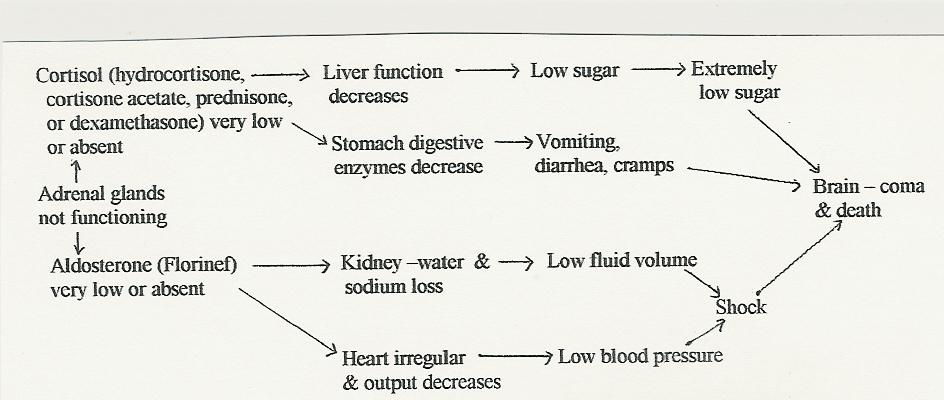
What You Must Know about Adrenal Crisis

I just found this page of VERY IMPORTANT information about adrenal crisis that Cushing's patients often face, either after pituitary surgery or after their adrenal glands are removed in a procedure called bilateral adrenalectomy, or BLA.

I am thankful to MaryO, the founder of Cushing's Help & Support.com and Cushie.com

This adrenal crisis page is a very informative for the patient, the caretakers, and emergency medical folks.  Many Cushies print this information and carry it along with their hydrocortisone and Solu-cortef (actovial) meds. They post the information on their refrigerators.

Be sure to read patient stories such as mom Jackie and daughter Sam's situation that went very, very wrong in Robin's post, Stars Go Blue. It brings tears to my eyes every time I read it.

This graphic from Sue explains it all, in a nutshell: