“Genetics and runaway appetite are not the only causes of obesity. Sometimes, your own body can turn against you in ways you never thought possible.” ~The Science of Obesity
A new friend who is facing a Cushing's diagnosis lamented her recent attempt to find a swimsuit for her pregnant-looking Cushie body. She knew she didn't need to let changes to her body affect her image of herself, but it did. She knew she was using society's standards as the yardstick of her personal worth. She asked us for advice.
This topic has invaded the conversations of Cushies for my whole eight years and probably even before. The damage of high cortisol is pervasive, altering the total self --mind, body, and soul. With debilitating effects from a disease no one has heard of (except the vets in your life), the Cushie feels an unfair burden to be a good patient: positive, happy, and strong, not letting the disease change who you are.
Cushing's is insidious. It breaks you down on the inside and outside, and it never lets up. The disease itself prevents you from having the strength in body and mind to fight. Others simply don't understand.
High cortisol damages your muscles including your heart, steals your physical strength, and keeps you from doing daily chores that you never use to consider real activity in your days. Forget climbing stairs, getting up easily from a chair, or standing for five minutes. Cushing's says no to that.
High cortisol also gives you additional
diseases that specialists never consider are related to each other: acid reflux, diabetes, irritable bowels, broken bones, tooth problems, headaches, and unrelenting fatigue. Others do not understand how fatigue cloaks a Cushie in a cement blanket that eliminates any fun of celebrations, family gatherings, or simple trips to the market.
High cortisol affects your brain with anxiety, depression, memory lapses, and confusion. Cushing's makes you feel dumb.
High cortisol takes your ego and replaces it with "ugly symptoms" of unstoppable weight gain, excess hair where women shouldn't have it, red or purple stretch marks, acne, hair falling out, and that buffalo hump you notice when you put your hair in a ponytail.
With all this swirling in my mind, I answered my new friend. On New Years Eve 2013, bilateral adrenalectomy began my escape from high cortisol, after seven grueling years of fighting for a cure.
"This disease is awful. No doubt. Welcome to the days when you learn to love yourself for all that you are, not what you can do or what you look like. In the end, not caring what others think is a very good lesson Cushies learn, and while difficult, it is exactly what we need to learn."
ATTN: Cushing's patients who take growth hormone injections. Ask your doctor for a prescription of hydrocortisone and keep it with you at all times. Keep yourself from getting adrenal insufficiency and take a few a day.
Have doctor write the generic prescription like this: hydrocortisone (brand greenstone) 5 mg bid pd x 90.
Greenstone hydrocortisone is Pfizer's generic. So, when the Rx is written that way, you will get brand CORTEF at the generic price. The name CORTEF 5 will be printed on each pill.
Keep yourselves safe. Fight with Moxie. Xoxo
Melissa
Health Alert: Adrenal Crisis Causes Death in Some People Who Were Treated with hGH
Doctors conducting the follow-up study of individuals treated with hGH looked at causes of death among recipients and found some disturbing news. Many more people have died from a treatable condition called adrenal crisis than from CJD. This risk does not affect every recipient. It can affect those who lack other hormones in addition to growth hormone. Please read on to find out if this risk applies to you. Death from adrenal crisis can be prevented.
Adrenal crisis is a serious condition that can cause death in people who lack the pituitary hormone ACTH. ACTH is responsible for regulating the adrenal gland. Often, people are unaware that they lack this hormone and therefore do not know about their risk of adrenal crisis.
Most people who were treated with hGH did not make enough of their own growth hormone. Some of them lacked growth hormone because they had birth defects, tumors or other diseases that cause the pituitary gland to malfunction or shut down. People with those problems frequently lack other key hormones made by the pituitary gland, such as ACTH, which directs the adrenal gland to make cortisol, a hormone necessary for life. Having too little cortisol can be fatal if not properly treated.
Treatment with hGH does not cause adrenal crisis, but because a number of people lacking growth hormone also lack ACTH, adrenal crisis has occurred in some people who were treated with hGH. In earlier updates we have talked about how adrenal crisis can be prevented, but people continue to die from adrenal crisis, which is brought on by lack of cortisol. These deaths can be prevented. Please talk to your doctor about whether you are at risk for adrenal crisis.
Why should people treated with hGH know about adrenal crisis? Among the people who received hGH, those who had birth defects, tumors, and other diseases affecting the brain lacked hGH and often, other hormones made by the pituitary gland. A shortage of the hormones that regulate the adrenal glands can cause many health problems. It can also lead to death from adrenal crisis. This tragedy can be prevented.
What are adrenal hormones? The pituitary gland makes many hormones, including growth hormone and ACTH, a hormone which signals the adrenal glands to make cortisol, a hormone needed for life. If the adrenal gland doesn't make enough cortisol, replacement medications must be taken. The most common medicines used for cortisol replacement are:
Hydrocortisone
Prednisone
Dexamethasone
What is adrenal crisis? Adrenal hormones are needed for life. The system that pumps blood through the body cannot work during times of physical stress, such as illness or injury, if there is a severe lack of cortisol (or its replacement). People who lack cortisol must take their cortisol replacement medication on a regular basis, and when they are sick or injured, they must take extra cortisol replacement to prevent adrenal crisis. When there is not enough cortisol, adrenal crisis can occur and may rapidly lead to death.
What are the symptoms of lack of adrenal hormones? If you don't have enough cortisol or its replacement, you may have some of these problems:
feeling weak
feeling tired all the time
feeling sick to your stomach
vomiting
no appetite
weight loss
When someone with adrenal gland problems has weakness, nausea, or vomiting, that person needs immediate emergency treatment to prevent adrenal crisis and possible death.
Why are adrenal hormones so important? Cortisol (or its replacement) helps the body respond to stress from infection, injury, or surgery. The normal adrenal gland responds to serious illness by making up to 10 times more cortisol than it usually makes. It automatically makes as much as the body needs. If you are taking a cortisol replacement drug because your body cannot make these hormones, you must increase the cortisol replacement drugs during times of illness, injury, or surgery. Some people make enough cortisol for times when they feel well, but not enough to meet greater needs when they are ill or injured. Those people might not need cortisol replacement every day but may need to take cortisol replacement medication when their body is under stress. Adrenal crisis is extremely serious and can cause death if not treated promptly. Discuss this problem with your doctor to help decide whether you need more medication or other treatment to protect your health.
How is adrenal crisis treated? People with adrenal crisis need immediate treatment. Any delay can cause death. When people with adrenal crisis are vomiting or unconscious and cannot take medicine, the hormones can be given as an injection. Getting an injection of adrenal hormones can save your life if you are in adrenal crisis. If you lack the ability to make cortisol naturally, you should carry a medical ID card and wear a Medic-Alert bracelet to tell emergency workers that you lack adrenal hormones and need treatment. This precaution can save your life if you are sick or injured.
How can I prevent adrenal crisis?
If you are always tired, feel weak, and have lost weight, ask your doctor if you might have a shortage of adrenal hormones.
If you take hydrocortisone, prednisone, or dexamethasone, learn how to increase the dose when you become ill.
If you are very ill, especially if you are vomiting and cannot take pills, seek emergency medical care immediately. Make sure you have a hydrocortisone injection with you at all times, and make sure that you and those around you (in case you're not conscious) know how and when to administer the injection.
Carry a medical ID card and wear a bracelet telling emergency workers that you have adrenal insufficiency and need cortisol. This way, they can treat you right away if you are injured.
Remember: Some people who lacked growth hormone may also lack cortisol, a hormone necessary for life. Lack of cortisol can cause adrenal crisis, a preventable condition that can cause death if treated improperly . Deaths from adrenal crisis can be prevented if patients and their families recognize the condition and are careful to treat it right away. Adrenal crisis is a medical emergency. Know the symptoms and how to adjust your medication when you are ill. Taking these precautions can save your life.
# # #
National Endocrine and Metabolic Diseases Information Service
The National Endocrine and Metabolic Diseases Information Service is an information dissemination service of the National Institute of Diabetes and Digestive and Kidney Diseases (NIDDK). The NIDDK is part of the National Institutes of Health, which is part of the U.S. Department of Health and Human Services.
The NIDDK conducts and supports biomedical research. As a public service, the NIDDK has established information services to increase knowledge and understanding about health and disease among patients, health professionals and the public.
This publication is not copyrighted. The NIDDK encourages users of this publication to duplicate and distribute as many copies as desired.
My compassion for and interest in illnesses, especially the rare or mysterious, has exploded since my Cushing's diagnosis in 2007. I now can relate to the pain and suffering, the daily struggle, the dashed hopes and dreams punctured by mental and physical ailments. This is a hard life, we can all try out best, but wow, it's a lot to bare. I've also become friends with many mother-child pairs, as the parent fights for the diagnosis and treatment of the child's Cushing's. That experience in blood draws, midnight testing, brain MRIs, brain surgeries, and withdrawal symptoms is also my experience. I totally agree: this life is not glamorous at all.
Take a moment to read this story from a teenager who is chronically ill. As an aside, several Cushing's patients develop POTS after bilateral adrenalectomy, but we patients can not determine the pattern or relationship between the two illnesses.
Hollywood has it wrong: I'm a teenager with an illness, and it's not glamorous at all
Lessons of Alexis Shapiro: Texas Girl's Ordeal Spotlights Silent Crisis
BY BILL BRIGGS
A Texas pre-teen's medically induced obesity and subsequent slim-down has led her parents to a broader mission: Ensure that people with dangerous adrenal insufficiency get the right treatment in emergencies.
Alexis Shapiro's condition, caused by removal of a benign brain tumor three years ago, prompted nonstop hunger that pushed her weight above 200 pounds. Life-saving surgery in March has left her 50-plus pounds trimmer.
But her mother, Jenny Shapiro, said Alexis remains vulnerable to potentially lethal blackouts linked to adrenal insufficiency or AI — a little-known condition that a leading specialist says might be vastly underdiagnosed and could affect several million people in the U.S.
Alexis' condition must be painstakingly managed via oral steroids and 24/7 access to a needle and the drug Solu Cortef, which must be injected within 30 minutes after serious symptoms arise. Yet the vast majority of ambulances don't carry the drug.
Shapiro is banding with a network of"friends and family" impacted by AI to lobby for all EMS units to carry Solu Cortef — and to urge that all first responders learn more about the illness.
People with AI lack vital hormones produced by the adrenal glands. The paired organs sit atop the kidneys, flooding the body with chemicals that, among other things, maintain blood sugar, blood pressure and cardiac output during stress, said Dr. Michael Freemark, chief of pediatric endocrinology and diabetes at Duke University Medical Center.
Some people are born with AI. But far more — possibly "several million," said Freemark, who supports the push for EMS units to carry Solu Cortef — have secondary adrenal insufficiency caused by brain tumors (and their removals), strokes or long-term use of administered drugs like prednisone and hydrocortisone.
The worst symptoms of AI can include disorientation, shock, organ failure and death, unleashed by stress, sudden injury or illness.
"I told them she has adrenal insufficiency and was going to need her shot at the hospital. She was white as a sheet, shaking, going into crisis."
Two close calls with AI have stricken Alexis — the second aboard a jet as sheflew to Cincinnati last spring for the gastric-sleeve operation that curbed her ravenous appetite. (NBC News has followed Alexis' journey since December.)
But it was the first terrifying episode at her kitchen table about a year ago that launched Jenny Shapiro's latest fight for her daughter, who wears a medic-alert bracelet revealing she has AI. A chair accidentally landed on and fractured Alexis' pinky toe — and the injury triggered an adrenal crisis.
"Before the ambulance got there, she said everything was going dark," Sharpiro said.
The mother gave Alexis five steroid pills to swallow — what's known as a "stress dose." (She normally takes one pill in the morning, one at night.) She hoped her daughter would keep the meds down. Vomiting is a common symptom of adrenal crisis. Sharpiro also agonized about giving Alexis an emergency Solu Cortef shot in case her stomach heaved up the tablets. As the EMS team arrived, Shapiro urged them to rush Alexis to the hospital. They urged her to "calm down."
"A lot of paramedics don't know what it is. When they came to my house when Alexis was in crisis, they kind of blew me off when I kept asking if I should inject her. They didn't know what I was talking about," Shapiro said. "That, plus not having the medication on ambulances, creates a dangerous situation."
FAMILY PHOTO
Philip Hart, who died in 2009 at age 22 of an adrenal insufficiency crisis.
Many people likely wouldn't learn they have AI until they lapse into a disorienting adrenal crisis, said Eric Hart. He lost his 22-year-old son, Philip, to an adrenal crisis caused by undiagnosed Addison's disease. Philip's adrenal crisis was triggered by a bout of flu.
His death spurred Hart to start 4Philip.org, a nonprofit in the Raleigh, North Carolina, area that has persuaded a local EMS training school to list adrenal shock as an illness paramedics must consider when assessing patients.
"Like Alexis' parents discovered, Solu Cortef is not carried on ambulances — something we seek to change," Hart said. "This needs to go nationwide."
Adrenal Insufficiency United is spearheading the drive to raise awareness among medics and, perhaps eventually, equip every ambulance with a $7 vial of Solu Cortef, a corticosteroid that restores the body's crashing hormonal chemistry and helps people in adrenal crisis to start recovering.
The nonprofit, based in Eugene, Oregon, was formed by Jenny Knapp, whose 18-year-old daughter was born with AI (Knapp's daughter, who wears a medic-alert necklace, prefers not to be named).
Knapp's daughter has a horror story similar to Shapiro's. The triggering incident was a car accident.
"I did not have the Solu Cortef injection with me because my (daughter's doctor) told me EMS squads carry it and would give it to her," Knapp recalls. "The ambulance got there. They didn't have it. I told them she has adrenal insufficiency and was going to need her shot at the hospital. She was white as a sheet, shaking, going into crisis. They barely looked at her."
On Tuesday, Knapp's group launched anonline petition to establish new emergency policies to treat adrenal crises, emphasizing "timely treatment prevents needless disability and death." By Friday, more than 3,000 people had signed the petition.
"You have a $7 injection versus someone becoming permanently disabled or dying from this," Knapp said. "Is this a third-world country where people are dying because of (the lack of) a $7 injection on ambulances?
"I don't blame EMS (emergency medical services) for this," Knapp said. "What they hear in training about adrenal insufficiency is maybe a couple sentences. They want to help. I'd love all EMS to carry Solu Cortef. However, that's not going to work for (all EMS units). Our solution is: 'Why don't you (paramedics and EMTs) just inject the patient-carried meds?'"
But that option is unsafe, contends Dr. Alfred Sacchetti, an emergency-room physician in Camden, New Jersey. He also speaks for the American College of Emergency Physicians (ACEP), an organization that includes EMS directors.
"If they want the ambulance squads to give their kids Solu Cortef that someone pulls out of the refrigerator, that's not fair to an EMS squad," Sacchetti said. "The paramedics would think: 'What's really in this vial? How much do they get?' The whole thing is very suspect."
The better choice, Sacchetti asserts, is to treat people in adrenal crisis with Solu Medrol, a glucocorticoid carried by every EMS responder. That drug will "buy you time," stabilizing the patient until they reach a hospital, he added.
"I've talked to some of these parents at length: 'I understand, you've got a child with a special problem and I sympathize.' But I can't say to every EMS squad: 'You must carry all of these very unusual drugs for the three people in the state who have this disease.' You couldn't justify the cost," Sacchetti said.
Freemark, the AI specialist from Duke University Medical Center, disagrees with that stance — and with the number of people perhaps afflicted. He believes all EMS units should carry Solu Cortef — and should include AI among the assessment protocols used to evaluate patients in distress.
"It is a potentially life-threatening condition," Freemark said.
I am happy to introduce my new series, Hug your Cushie. Life as a Cushie is rough. You see it happen to your loved one or friend. You drive them there. You are there for the lab results and surgeries. Yet, you don't really experience the difficulties first hand. I want a way to show caregivers just some of what we experience. What if this were you?
This is not a "woe is us" series. This is a "warriors keep going no matter what series." It is important that caregivers and friends understand this, I mean, really understand the toll this takes on a patient. I hope that after being a Cushie for a few moments that you understand the physical and emotional challenges we face. Be sure to Hug your Cushie today.
Hug your Cushie: What is getting an MRI like?
I found this informational video intended for patients who need to undergo an MRI.
I patiently watched that video. It all sounds pretty doable. Pleasant even! Well, why do I associate this machine with a torture chamber?
I have been getting MRIs every six months for seven years now. I used to convince myself that it was no big deal. It was, after all, just what had to happen as a patient with pituitary tumors.
Stoic. I'm always trying to be stoic.
The last time I went for my pituitary MRI with dynamic protocol, I asked my dear friend Melony to tag along as "moms play date." I promised her dinner afterwards, but one condition: she could not make me laugh in there. Melony held on to my leg the whole time. At the end, she asked, in tears, how I can stay so strong every time? I told her that I really am not! I hate that machine! I hate the noises! I hate the head contraption that keeps my neck from moving. I hate lying in a tube where my whole body is touching the bottom and sides of the tube, with only four inches of space between my chest and the top of the MRI tube. I hate MRIs. There. I said it.
I don't have to be brave and mask all the challenges of being a patient. However, I will continue to get MRIs, as my treatment plan requires me to do, for the rest of my life. I will always look forward to getting out of those tubes and on to more magical sounds.
Some awesome person recorded the sounds of an MRI for 35 minutes. Click below, lean way into your speakers, even put your ear right on the speaker. Then stay put. See how long you can stay there before you pull away from the clicking and hammering sounds. Then remember, we Cushing's patients can not stop and move the noise. We have to float our minds off to a special place where we joyfully pass each minute in peace and quiet.
If you like what you see here, share the blog. Please do not lift links or images then share them. Blog authors spend time away from family, time when they are sick, to make these posts. Hug a Blogger. 😊
I have been disappointed, however, that when I arrived in California in late 2011, I was unable to access my results in a timely manner or in an app! California law prohibited Quest from releasing these results to me. Since then, I have struggled waiting for my doctor to release results to me. Why should I need to wait? I need these numbers to adjust medications quicker than a doc can return the phone call.
Well, I paid a bill online with Quest Diagnostics, and I see a new message. They have a new app as their patient portal. Instead of Gazelle, we have MyQuest by Care 360. The system recognized my old user name and password. I saw this message when trying to request lab results:
Based on California law, Quest Diagnostics is delaying release of test results for 14 days to allow your physician time to review your test results.
Hot diggity! This is something new! Oh, I have so much relief now knowing that the minimum I will wait is 14 days after the date of labs.
Well, this day just got a little sweeter.
-------------
Why is this a big deal? Patients are becoming more confident and informed consumers in the medical marketplace. In addition, those of us plagued by chronic illness need every bit of information about our case at our disposal, to pass along to other medical providers as needed. In addition, patients will research ever line item on the lab report to ensure they understand the result from each test. Doctors are notoriously for telling a patient the results are normal. Many times, even when cortisol levels are tested and abnormally high, doctors dismiss them as normal. No Cushie should have their life and diagnosis delayed because the doctor misread or didn't value that abnormal results, or even still, *know what to do with this abnormal test*! Patients must keep a file and stay informed. Know one will care more for your health than you.
The Cushing's community has bemoaned the absence of any cortisol-measuring device for the patient's use. Now after my bilateral adrenalectomy, it is critical that I know what my cortisol levels. I must adjust my hormone replacement, avoid taking too much and giving myself Cushing's, and worse, taking too little and suffering adrenal crisis. We are desperate for a way to measure cortisol levels outside a lab setting. We need tests results quickly.
Here is the recent announcement for a cortisol-measuring device. After this gets FDA-approval, it will save lives. Such a burden will be lifted for me, my family, and the entire Cushing's community.
""When cortisol levels are overlooked too many people suffer and die because of excess or insufficient cortisol," said Joel Ehrenkranz, MD, director of diabetes and endocrinology at Intermountain Medical Center, and lead researcher of the project.
To help solve this problem, researchers developed a simple saliva test that uses a smartphone and an attached device that inexpensively feeds the results of a saliva test into the smart phone. An app then quantifies and interprets the results of a salivary cortisol assay and gives results in five minutes at the point of care."
Because Cushies can have very specific body changes, such as moon facies, red cheeks, supraclavicular pads, this type of disease database can help an ailing yet undiagnosed Cushie. Also, the technology could easily be expanded to help adults as well as children.
*~* Your Family Photo Facebook Album Could Help Doctors Diagnose if Your Child Has a Rare Genetic Disease *~*
Digital photos are proving to be important medical tools to help doctors diagnose rare genetic disorders in children. "The future of medicine can live in a selfie."
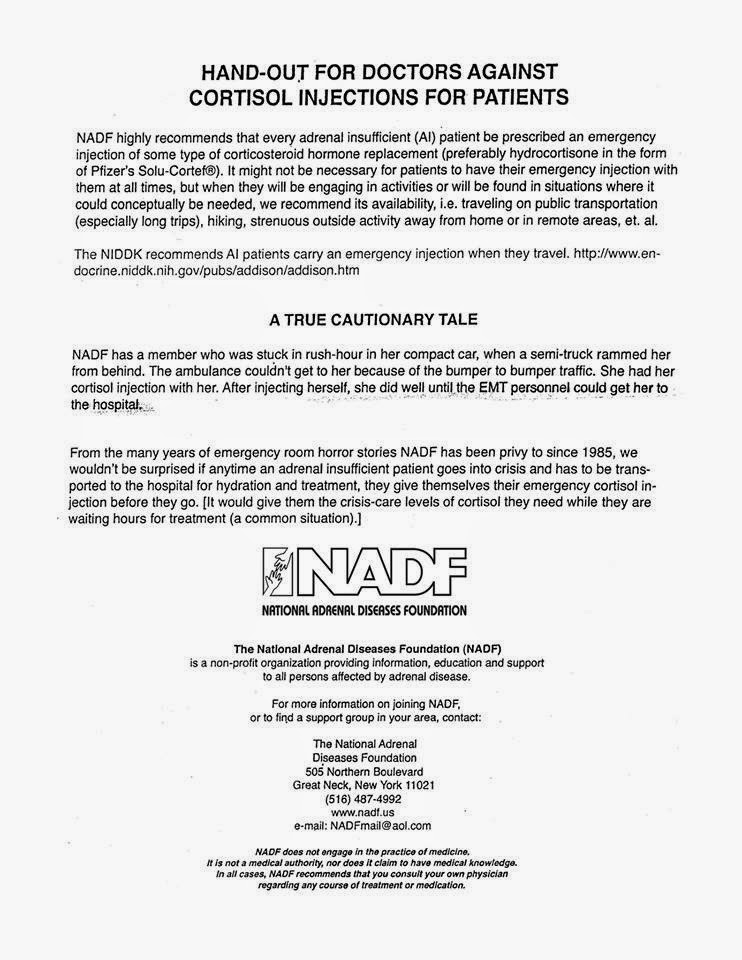
It is of the utmost importance that people with primary adrenal insufficiency [bilateral adrenalectomy(BLAers) and secondary adrenal insufficiency (Cushies after pituitary or adrenal surgery) are prescribed and allowed to carry Solu-Cortef Act-o-vial injections with them at all times.
I recently took a poll among BLAers, and 15 of 80 patients were not given prescriptions for the emergency injections. Many endocrinologists refused to prescribe them and some even were chastised for their silliness in asking.
Be sure your doctor writes the RX for Solu-Cortef ACT-O-VIAL.
I was furious.
This is what you tell your endocrinologist in words an endocrinogist should understand:
**A person with adrenal insufficiency (no adrenal glands, post op Cushies) need a Solu-Cortef emergency injection like a type 1 diabetic needs an glucagon shot. Period. **
For those without the emergency injection, I want you to know that those with it always have it available in the house AND take it with us wherever we go. We carry two needles, Solu cortef actovial medication, crisis letter from our doctor about treatment in the hospital, plus additional info to advise ambulance personnel or even the emergency room staff how to treat adrenal insufficiency.
Ask your nurse and doctor friends if they know where the adrenals are. Then ask them what they do. People don't know. It's sad and shocking but true. Not even the nurses and doctors in the emergency room know what to do in the event of your adrenal insufficiency or crisis. Many in this group of 95 have horror stories about ER hospital staff refusing to give Solu cortef, refusing to read/ disregarding the crisis letters from my doctors. Some refuse to take patients back quickly to check blood pressure, and instead leave them in the waiting room for hours. ER staff thinks you have the flu or a bad stomach but when you vomit uncontrollably, or they label you a drug seeker.
SOLU CORTEF 100 MG IS NOT A CONTROLLED SUBSTANCE!!
There is no reason besides ignorance and stubbornness for them to treat us like that.
The *one* safeguard we have is to save ourselves by keeping the shot with us at all times and ensuring those closest to us can administer that shot to us. Some lose consciousness (synscope) with adrenal insufficiency, while many get very confused, can't communicate, and can't manage to do the shot themselves.
I have not met 95% of you, I know. However, I would be devastated if we lost any of you.
I will tell your family to sue the doctor if you die. Not giving a pre-op Cushie and especially a BLAer an emergency shot is a malpractice suit waiting to happen. Remind the doctors of that.
*******
Friends posted this letter from the National Association for Rare Diseases for care in emergency rooms (link) as well as a letter to doctors who refuse to prescribe the Solu-cortef medication. This can save a person's life.
ASSIGNMENT 13: The 'pain' of feeling caught in the middle
Fellow Cushie Vanessa is featured in the article below about patients with chronic pain issues being frustrated with being questioned about using their pain killers for other purposes!!
Our planet Earth is comprised of billions of people of different faiths, cultures, and customs. Some are so different that people go to war. With all the things about us that make us different, there seems to be one world view that we share:
Fat is bad.
I don't feel well enough to do the google search, but I'm sure there are studies that show women would rather be dead than fat. Our society is just that shallow.
How do you dismantle the American and whole world's belief that:
1) fat is bad;
2) if you are fat, you did this to yourself;
3) I may be fat but I'm not as bad as you, and until I am, then I can make fun of you.
It's all ridiculous, now, isn't?
Fat or not, medical or not, when will we just let people be, without commentary? Why does it inflate or deflate a person's self-worth to be thin or fat?
In my case and in the case of Cushies, we are fat for a reason.
For whatever reason a person is fat or overweight, just stay out of it. Why do you care? Don't you have anything better to do? We are out doing something better -- we are telling all these fatties that it just maybe ALL IN THEIR HEADS.
Many patients spend hours in bed struggling with life and wondering why doctors don't do more to help us. Why would he think I'm lying? Why won't she believe me? How can they get away with treating me that way? Why do I pay them when I get no help or answers? No interest? Furthermore, we wonder why doctors don't know about Cushing's.
Endocrinologists treat diabetes and thyroid patients. That's probably 85% of their case load. So in walks a pituitary or adrenal patient, and a doc may not be ready to dust off the information in their minds where such treatment notes lay dusty. Instead of telling the patient they are a little rusty or they will get back to us after some research, the doctor blames us. It's our fault. We are doing something wrong or not doing enough of what we are doing right. It's always the patient who is wrong, not them.
The National Academy of Hypothyroidism has provided an evaluation of the problem that is so spot on, I can't actually believe I am seeing it in print. It is a honest yet searing look at doctors as business owners and less like medical minds who took an oath to "do no harm."
Give this a read, and you will quickly see that patients aren't benefitting from this method of medicine or from the continuing education credits doctors register with their professional societies.
"Similarly, the Endocrine Society, the American Association of Clinical Endocrinologists and the American Thyroid Association also have a long history of guidelines and recommendations that are not supported by the medical literature and fail to adjust or abandon recommendations when new understanding and knowledge contradicts their recommendations. A case in point is the recommendation by these societies that a normal TSH adequately rules out thyroid dysfunction, despite massive amounts of literature that demonstrate this not to be the case (see Diagnosis of Hypothyroidism) or that T4 only replacement is adequate for most patients. A doctor who simply follows outdated society treatment guidelines that relies on a simple laboratory test and ignores the clinical aspects of a patient is not practicing evidence-based medicine. (1-7). Such doctors may be adequate as lab technicians, but as doctors and clinicians they fall short (1-7). This method of practice is consistently rebuked as improper and poor medicine, but has become the standard used by a large percentage of endocrinologists and physicians who feel medicine can be related to simply reading "normal" or "abnormal" in a laboratory column."
How do you ensure that you are telling your doc everything you can, all information is accounted before the appointment arrives?
5 Things to Do When Symptoms Are Not 'All in Your Head'
"Half the battle is putting a name to your condition and understanding whether it's treatable and/or curable. The other half is trusting yourself as an accelerator and facilitator of the diagnostic process. By learning from Val's experience, you may be able to take charge and save yourself years of frustration and anguish."
The world's largest online library of high-resolution 3D scans using real human data—at your fingertips! TheVisualMD uses the most advanced 3D medical technologies to create its one-of-a-kind visualizations. You'll find accurate, detailed images of subjects ranging from angioplasty procedures to brain synapses to yoga positions.
Female Patient found Unconscious with Syringe Nearby
Paramedic's misdiagnosis of drug overdose could have cost patient her life, Journal of Emergency Medical Services, Jul 20, 2012
"A call comes in to 9-1-1 dispatch. “Help” is all that’s spoken before the operator hears the phone hit the floor. The 9-1-1 dispatcher calls back only to get a busy signal. Police and EMS are dispatched for a well-being call. On arrival, the front door is found to be slightly ajar. The crew knocks, but there’s no reply. They find a young woman lying on the floor... in a pool of vomit."
Sound familiar? This lady is having an adrenal crisis, and the article below from the Journal of Emergency Medical Services explains what happened when the paramedic treated her for a drug overdose instead of recognizing the symptoms of adrenal insufficiency.
Before we get the article, let's be clear. This article is just another example of what we Cushies already know. Medical expertise about our conditions, Cushing's and adrenal insufficiency, is limited, even in the emergency rooms meant to save everyone. We know that doesn't apply to us. We are bombarded with weekly stories detailing horrible treatment at the hands of ER doctors and nurses. Even with an unhelpful doctor, a family member or friend can be the difference, the force that demands attention to our plight.
This is why I am so passionate about advocating for Cushing's Awareness and educating Cushies and their families about the dangers of adrenal crises. I do this as I struggle and because I struggle to deal with the complacency of my own.
I'm confounded as to why family and friends around me aren't too startled or concerned when I say I could die if I forget a dose of medication or if a physical or emotional stressor is more than the medication I consumed for the day.
Do they think I'm kidding?
Do they think I'm exaggerating?
I would neither kid or exaggerate about my daily situation.
I have been told to "Stop thinking like that" or "That's not ever gonna happen to you." When I try to explain that I have many friends that have faced adrenal insufficiency and adrenal crisis -- 20 or more a year I'd guess -- they just brush me off. They aren't hearing what I am saying. My feelings aren't just hurt; inside, I am panicking.
This isn't a punchline or a Debbie Downer moment when I tried to show my life is more delicate that yours.
MY LIFE IS A DELICATE BALANCE.
I tell you this because I am scared.
I tell you this so that if something happens and I fall unconscious in your presence, I can find comfort in the fact that you will help me.
I tell you so that I will feel safe going somewhere without my husband or "out on my own" with someone who doesn't acknowledge or understands my new condition.
I tell you this because I have a great desire to leave this house occasionally and dip my feet into life and try to live again in the world.
Your response doesn't sit well with me! Are you in denial? I can't live like that! I can't pretend this doesn't exist. I can't ignore my illness, and frankly, I just can not have you do that either.
I'm scared shitless that because no one listens to me, no one will help me and I will die accidentally.
People do, you know. Die from this.
Cushies with no adrenals like me or others after pituitary surgery die because people around them didn't know the situation was serious.
I do not want to die that way.
Can I count on you to listen to me? To let me tell you know what to do for me?
Can I count on you to say:
* Don't worry. I got this.
* I won't let anything happen to you.
* Show me how to give you the emergency shot.
* I will make sure the EMS and ER folks understand the severity of your case.
* I will show them your medical bracelet.
* You aren't gonna die on my watch.
Seriously. That's all we want to hear. We want to hear that you love us enough to learn to keep us safe. We love you, and we want you to love us enough to save us. Will you do that? Can we count on you to do that?
-------------
Here's a story about a lady. Things lined up pretty well for her. Someone paid attention. One doctor out of thousands practicing out there in ERs across the world, on the medical front line, recognized the medications. This doesn't happen every time. Don't fooled by the ending.
Female Patient found Unconscious with Syringe Nearby - Case of the Month
Fri, Jul 20, 2012 Paramedic's misdiagnosis of drug overdose could have cost patient her life, Journal of Emergency Medical Services, Jul 20, 2012
A call comes in to 9-1-1 dispatch. “Help” is all that’s spoken before the operator hears the phone hit the floor. The 9-1-1 dispatcher calls back only to get a busy signal. Police and EMS are dispatched for a well-being call.
On arrival, the front door is found to be slightly ajar. The crew knocks, but there’s no reply. They find a young woman lying on the floor, naked, and in a pool of vomit. A syringe with an unknown substance is on the ground nearby. Suspecting a drug overdose, the EMS crew begins treating the patient for this condition. The patient is unconscious with emesis around her head and face. Her vital signs are blood pressure 60/45, heart rate of 130 bpm and respiratory rate of 10. The patient shows no signs of waking. The crew clears the airway and administers oxygen. An IV is established, and the patient is readied for transport. As the crew leaves the scene, one of the medics turns to shut the door and sees a vial under a chair. He retrieves it and notes that the label says Solu-Cortef (a glucocorticoid). He bags it for the emergency department (ED). Following his instinct, he looks around the area for medications and finds two bottles. One is labeled dexamethosone and the other is labeled fludrocortisone. He takes his findings and rushes out the door into the awaiting ambulance. During transport, the patient continues to deteriorate.
The medic administers 0.5 mg of narcan and a 500mL bolus of normal saline with no response. He radios ahead to let the hospital know that they’re en route. Now questioning the original diagnosis of drug overdose, he reports the medications he found on the scene in hopes it will help the receiving physician determine the cause of the patient’s condition.
Arrival at the ED On arrival to the ED, the medic hands over the loaded syringe containing 2mL of unidentified solution, as well as the empty vial of Solu-Cortef and the bottles of dexamethosone and fludrocortisone.