Saturday, November 9, 2013
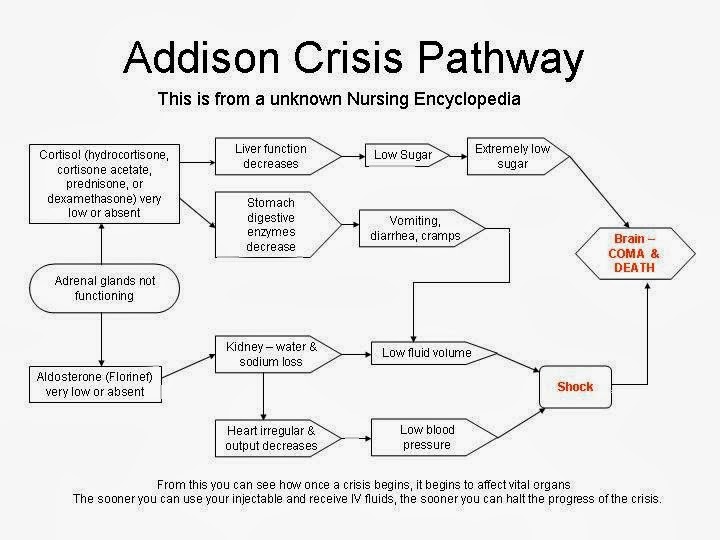
Adrenal Crisis Pathway


Friday, November 8, 2013

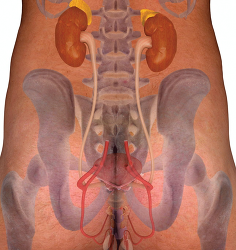
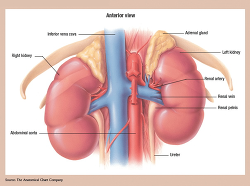
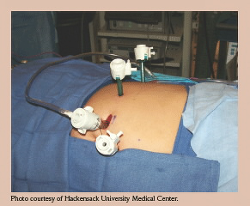
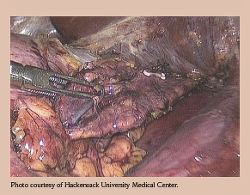
Adrenalectomy through the Nurse's Eye
 | |||
| | | Perioperative care of the laparoscopic adrenalectomy patient OR Nurse 2013, November 2010
| |
| |||
| | |


| CE Collection | | |  Go to CE Details Go to CE Details |
For more information about taking CE on NursingCenter, view our Help and Accreditation Information.
Beyond pituitary surgery: Radiosurgery vs. Adrenalectomy vs Medical Treatment when Cushing’s disease persists or recurs
I found this presentation today.
It's for people like me who suffer from refractory Cushing's and want to understand all the options.
http://www.goodhormonehealth.com/forpatients/CUSHINGS-beyond%20surg-magic09jan11%5B1%5D-1.ppt
It's for people like me who suffer from refractory Cushing's and want to understand all the options.
http://www.goodhormonehealth.com/forpatients/CUSHINGS-beyond%20surg-magic09jan11%5B1%5D-1.ppt
Thursday, November 7, 2013

BOOM - more high cortisol results
One day of four received.
Test results from 10/31/2013
15.4 HIGH diagnostic midnight cortisol serum (n<5, diagnostic >7.5)
0.37 HIGH midnight saliva cortisol (n< 0.09)
10.8 HIGH 17-ohs (n 2-6)
17.4 ------ cortisol, free, urine (n 4-50)
MN Cortisol serum is DOUBLE the diagnostic value of 7.5.
Saliva cortisol is FOUR times the upper limit of normal.
17-hydroxycorticosteroids is also high, as it always is for me.
Free cortisol is normal, as it always is for me.
Wednesday, November 6, 2013
Adrenal Surgery Treatment & Management
I have read a lot about bilateral adrenalectomy in general terms. Now, it is time that I know the specifics. This articles goes into more detail about the surgery than others I have seen to date.
Some of you may not want to know what happens, some like me do. It is here if you want it. No graphic photos.
http://emedicine.medscape.com/article/443536-treatment#showall
Some of you may not want to know what happens, some like me do. It is here if you want it. No graphic photos.
http://emedicine.medscape.com/article/443536-treatment#showall
Keto: It was fun while it lasted
I started Ketoconazole in August 2012 after having high midnight salivary cortisol, high midnight serum cortisol, and high urine 17-hydroxy-corticosteroids. Keto resolved some symptoms but not all. At best, I dropped and kept 15 pounds off. I felt less weak and average but still definitely not myself. The daytime drowsiness became unbearable by Spring 2013. I was falling asleep daily. It came across me suddenly, like narcolepsy. Dr F treated me with Ritalin two times a day. It kept me afloat.
In late Summer 2013, the FDA put stricter limits on the use of oral Ketoconazole. The European Union banned its use. Liver toxicity is such a concern that the FDA recommends weekly liver function tests?!
--ENOUGH SAID--
I side with the EU on this one. The EU bans many known endocrine disrupters years before the FDA even considers it: BPA in baby bottles, rGH in milk. I'm not taking that Keto stuff anymore. Cushing's has disrupted enough body systems on its own. I certainly don't want to lose liver function just trying to keep cortisol at bay. Keto wasn't a wonder drug for me!
I knew I had to stop Keto. It was hard to give up the little sleep Keto did allow me to get some nights. I was afraid to stop taking it. Being so tired each day anyway, I just didn't know how I would manage on no sleep with unmitigated cortisol running through my veins all night. After my pituitary MRI and CT scan of the adrenals in October 2013 were read as clear, I knew it was time to move on. Keto was only a crutch to avoiding the inevitable. It was time to get seriously prepare for a BLA. I stopped Keto, scheduled an appointment with my doctor, and began midnight testing. I had five high midnight cortisol serums right out of the testing gate.
After just a week since speaking to my doctor last, I am very close to getting cleared for a BLA (just waiting for some lab results to trickle in).
Thanks FDA for making a a difficult decision a little bit easier for me.
- Melissa

FDA Puts Strict Limits on Oral Ketoconazole Use
Tuesday, November 5, 2013
Pituitary Disorders and the Family
 | ||||||||
|
Webinar: Pituitary Disorders and the FamilyPresented ByJamie L. Banker, Ph.D. Director of Counseling Psychology
Seating is limited, register today!
Date: Friday, November 15, 2013 Webinar InformationChronic illness systemically affects individuals and families, in that the illness impacts the whole system, rather than just the individual with the diagnosis. Health problems can create or exacerbate conflict within a family or support system (Ruddy, Borresen, & Gunn, 2008). This is also the case within families with a family member with an endocrine disorder. Historically, research on medical illness focused mainly on the identified medical patient, but recent literature shows an ever-growing interest in understanding the physical and mental toll those managing and caring for close relatives with a serious illness or disability (Feigin, Barnetz, & Davidson-Arad, 2008). Family systems theories have influenced this turn, as it becomes clear that focusing on a problem with one family member acknowledges only one part of the affected system. In this presentation Dr. Banker will talk about what is meant by the "family system," what is meant by "collaborative' and "integrated" care, Dr. Banker will identify ways pituitary disorders impact the family system, She will discuss ways family members can positively impact healing and learn what can be the role of a "family therapist" in helping families affected by a pituitary tumor or other endocrine disorder. Dr. Banker will also talk about her most recent research connecting the early childhood trauma and pituitary disorders. Learning Objectives
Presenter BioJamie Banker is the Director of Counseling Psychology Masters program and Assistant Professor of Psychology at California Lutheran University in Thousand Oaks California. She is a Licensed Marriage and Family Therapist and has a special interest in integrated behavioral healthcare. She completed a clinical master's degree at University of San Diego and completed her doctoral degree at Virginia Tech. Dr. Banker was a doctoral intern at Dartmouth College Family Medicine Residency. Dr. Banker has worked in three integrated primary care practices as a therapist and a lecturer. She has published scholarly articles and a few book chapter on integrated healthcare. Now her focus is on training Marriage and Family Therapy students to work in integrated behavioral healthcare sites. She is an AAMFT approved clinical supervisor. Dr. Banker's research agenda centers on women's and family's health. It encompasses topics that are both underserved and burgeoning in the fields of psychology, marriage and family therapy, behavioral medicine, and public health. Dr. Banker's primary research interests are collaboration between family therapists and medical professionals, family health and training integrated care professionals. These interests all fall under the larger umbrella of improving individuals' overall healthcare. Her research agenda is focused on decreasing the gap between medical and mental health assessment and treatment. Dr. Banker's current research is on understanding postpartum depression and disorders of the endocrine system from a biopsychosocial model.
| ||||||||
 | ||||||||


Not interested any more? Unsubscribe

Monday, November 4, 2013
New Chapter of my Life

Hey everyone! I've missed you all. It's not that I haven't. I just haven't even able to keep up on posting like I wish I could. I hope you will always understand why and forgive me.
Today, I'm back with a big update.
I now walk the final steps towards BLA and a cure from Cushing's.
After two non-curative transsphenoidal pituitary surgeries, I spent many months wondering what to do and just trying to manage my symptoms. That has become increasing difficult and almost impossible for me as the days and months wore on.
I started ketoconazole in August 2012 with mixed results. I slept well sometimes but still would wake up at 4:00 am, a Cushie's witching hour. I felt good at the beginning but it started to wear off. I spent some hours in the ER on 10/10/12 as I faced severe symptoms of adrenal insufficiency. I needed IV saline and IV hydrocortisone when the injection of 100 mg of Solu-cortef my husband gave me at home wasn't working. I lost 23 pounds but I felt weak, unfocused, irritable, and overwhelmed. My daytime drowsiness was worse than ever. I complained to Dr F in June 2013 that I had narcolepsy; I would sit on the couch for only a few moments in the late morning or afternoon, and I would fall asleep instantly. This is after having sleeping six to eight hours. I would just pass out.
In the past few months, I've taken Ritalin at Dr F's suggestion, and it has worked to keep me awake during the day. I take a long-acting dose in the am and a short acting dose in the early pm.
I dropped the ketoconazole and a week later, I saw Dr F for an office visit last Monday. He said he needed recent tests before he could clear me for surgery. I tested every day and night until the early hours of Sunday morning.
Midnight cortisol serums
normal is less than 5
diagnostic is greater than 7.5
My results six nights in a row:
5.2, 16.1, 15.4, 8.8, 19.4, 10.8
I am pretty astonished. I had no idea I was high, much less this high. My high test value before was 12.8. My cortisol has been so high at night that my body is producing zero cortisol during the day. In the past, before testing, my body has been getting only the 20 mg of morning Cortef that I took while I was on Keto and it wasn't enough. My body was unhappy probably because it had become accustomed to such high levels of cortisol. Any drop have me symptoms of adrenal insufficiency: nausea, diarrhea, loss of appetite, extreme fatigue, muscle pain, joint point, grouchiness.
Now, I am pretty happy to have these test feathers in my rediagnosis cap. I am waiting for results on four UFCs w/ 17OHS and five salivas taken during the same time period as the high midnight cortisol serums. I feel good that some will be high.
I hope to be cleared for BLA within the week. There is no visible tumor on my pituitary. Even an exploratory third surgery is not wise, since my second neurosurgeon said surgery would "result in a guaranteed cerebrospinal fluid leak" based on the post operative tissue's location at the bottom of the gland. My doctor and I know that I am not a good fit for other medical therapies. It's BLA time. I plan on having a BLA before the end of the year, since insurance pays 100% now.
I have done everything I can in the last six years as a Cushing's patient. I have done everything the medical community has required of me, and many things that should not be required: guessing when to test, knowing what my body was feeling at every moment and what medication would best treat it, watching over every lab technician like a hawk, feeling guilty after outbursts of emotion towards my family and every time I missed family time so I could nap, even keeping up on refills of 15 medications and organizing a 31-day pill case, even when I wasn't sure I was feeling better from any of it. I have suffered in countless MRI machines that could barely hold my large frame but I made it through the hour with some anti-anxiety pills, pain meds, and a one moment at a time attitude.
This is my road. This is my path. I accept it. I feel relief and confidence. I am feeling peaceful and hopeful.
Stay tuned as a march my way towards my cure from the cortisol beast. Thanks for sticking with me.
- Melissa
Saturday, November 2, 2013
BLA takes a Patient from Cushing's to Addison's
Adrenal crisis in treated Addison's disease: a predictable but under-managed event
- Addison's Disease Self-Help Group,PO Box 1083, Guildford GU1 9HX
1School of Clinical and Experimental Medicine, Centre for Endocrinology, Diabetes and Metabolism, University of Birmingham College of Medical and Dental Sciences, Edgbaston, Birmingham B15 2TT, UK
- (Correspondence should be addressed to K White; Email:kgwhite@addisons.org.uk)
Abstract
Context Adrenal crisis is a life-threatening event that occurs regularly in Addison's patients receiving standard replacement therapy. Patient reports suggest that it is an underestimated and under-managed event.
Objective To assess the frequency of adrenal crisis in diagnosed patients and to understand the factors contributing to the risks of adrenal crisis.
Design We conducted a postal survey of Addison's patients in four countries, UK (n=485), Canada (n=148), Australia (n=123) and New Zealand (n=85) in 2003, asking about patients' experiences of adrenal crisis and their demographic characteristics. In 2006, a shorter follow-up survey was conducted in the UK (n=261).
Method The frequency and causes of adrenal crisis were compared across both surveys. Demographic data from the 2003 survey were analysed to establish the main variables associated with an elevated risk of crisis.
Results Around 8% of diagnosed cases can be expected to need hospital treatment for adrenal crisis annually. Exposure to gastric infection is the single most important factor predicting the likelihood of adrenal crisis. Concomitant diabetes and/or asthma increase the frequency of adrenal crises reported by patients.
Conclusion The endocrinologist has a responsibility to ensure that Addison's patients have adequate access to life-saving emergency injection materials and repeated, practical training sessions in how to use them, while the general practitioner plays a vital role as in arranging prompt emergency admissions.
Click through to read the full article on the European Journal of Endocrinology website.
Patient Access to Current Medical Literature
File this one under Learn Something New Every Day. To me, this is a BIG SOMETHING.
Doing research? Do you want to read a recent article?
The Endocrine Society grants access to patients upon request.
-------

Patient Request for Copy of an Article Recently Published by The Endocrine Society Journals
Please use this request for articles recently published in The Journal of Clinical Endocrinology & Metabolism, Endocrinology,Molecular Endocrinology, or Endocrine Reviews.
Note that all articles published more than 12 months ago back to 1997 are free to all online.
To receive your copy of the requested article, please provide the following information:
- Article information, including author(s), title of journal, title of article, issue date and page number. This information is available free online for all articles in the Table of Contents.
- Your name and e-mail address.
Please e-mail this information to Scott C. Herman at sherman@endo-society.org so that the staff at The Endocrine Society can assist you.
NOTE
For additional patient information on hormone-related conditions, free publications and a physician referral, visit The Hormone Foundation at www.hormone.org. The Hormone Foundation, the public education affiliate of The Endocrine Society, serves as a resource by promoting the prevention, treatment and cure of hormone-related conditions through outreach and education.
Monday, October 28, 2013
Reading your Rx
I'm in the midst of updating my massive medication list, as I am going to see my Cushing's specialist today. It occurred to me that after all these years of being sick, I still don't know how to read all the abbreviations on a prescription. Cushing's just won't allow me to commit some new things to memory, but thanks to Google, you and I can learn once these terms once and for all.
Thursday, October 10, 2013
SIGN THE PETITION: We deserve better than Solu Cortef
Cushies deserve a better emergency injectable device than the one option we have in Pfizer's Solu Cortef. This medication is used during an adrenal crisis, in an emergency (http://cushingsmoxie.blogspot.com/2011/12/my-friends-with-adrenal-insufficiency.html).
There are just too many steps for me to follow while semi-conscious before getting the high dose of steroid that will save my life.
There are just too many steps for my caregiver to follow when seeing me semi-conscious before giving me the high dose of steroid that will save my life.
Meet Rachel. She is doing something about it.

This mom is fighting to make it happen. Rachel, a British mother, desperately wants her child and family to have an easier way to administer emergency cortisol injections--like Solu-Cortef for her 14 year old daughter with hypopituitarism. Her daughter doesn't make any cortisol and relies on replacement steroids, like Addison's patients or Cushies after pituitary surgery or bilateral adrenalectomies.
Please read their story and consider signing the petition.
If you live in the United Kingdom, please sign this petition:
http://you.38degrees.org.uk/petitions/for-cortisones-sake-give-steriod-dependents-the-life-saving-injection-they-need
If you live elsewhere in the world, please sign this petition via facebook:
https://m.facebook.com/rachelpeglersavinglivesforsterioddependants/about?notif_t=page_new_likes&__user=100000742731717
Subscribe to:
Posts (Atom)