Showing posts with label adrenal glands. Show all posts

Friday, November 29, 2013

What We Know Just Changed: "Adrenal glands produce ACTH"

NOTE:  I wrote this blog entry after taking my sleeping pill for the night. I'll reread this in a few days and catch any errors. Right now, my eyes are blurry and my hands don't want to touch the correct keys. :)


What we know about Cushing's has just changed. I mean, for me, it has changed in a profound way, just in the reading of one press release online tonight.

I have seen many Cushing's patients go through one, two, or more pituitary surgeries once hypercortisolemia is detected.   Once doctors sheepishly diagnose patients with Cushing's, they shepherd us into pituitary surgery.  WHY?  
  • The medical literature indicates that 70% of Cushing's cases are due to a pituitary tumor;
  • Nodules rarely appear on the patient's CT scans of the adrenals that would suggest an adrenal source of Cushing's (syndrome);  
  • These patients can have high ACTH (indicating pituitary source) or normal ACTH, so the likely surgical target is the pituitary;
  • We patients seek a cure from this physical, emotional, and mental H- E- double hockey sticks, and we follow our doctors' advice;
  • It's all we know about Cushing's at this time in history.
Despite all that, unfortunately, patients are often uncured by pituitary surgeries and choose the last resort treatment of bilateral adrenalectomy (BLA) to stop high cortisol at its source and gamble for an improved quality of life.  My minds often drifts back to an informal online survey of Cushing's patients who underwent BLA as treatment indicate that their adrenal glands were "plump" and "dense when removed."  Surgeons note this upon removing the adrenal glands and often include this information into the surgical reports, and pathology reports show that Cushie adrenals often weigh much more than the normal four to six grams each with fat dessicated. It is not uncommon for a patient's adrenal glands to weigh 10 and 15 grams each.  How? Why?  For those I've spoke with online, we don't know the answer.  I personally haven't seen anything written about the size of adrenal glands in relation to high cortisol and Cushing's. These dense behemoth little trouble makers trick us, because they don't appear larger on the CT scans. Radiologist love to say "adrenal glands normal in size" or they run them together with no special mention, such as "kidneys, adrenals, liver, and pancreas appear normal in size".  The surgeon sees the size of the adrenals first, kinda like finding out the gender and weight of new babies, except our surgeon removes adrenal twins, both weighing more than their mamas and papas could safely carry, so they had to come out. The size of the babies are often a surprise to everyone!

Oh, yeah. Back to the press release that says "Adrenal glands produce ACTH."

Today after our Thanksgiving dinner and celebration, I happily turned to my new iPhone 5s, another thing for which I am extremely grateful (as well as communicating with people from my bed while resting).  I stopped in my tracks when I read this press release from the New England Journal of Medicine regarding a genetic link to bilateral adrenal Cushing's.  I couldn't believe my eyes.  

A test? A genetic link?  So this would tell if we patients indeed had Cushing's, which endocrinologists are always insisting we don't really have, and they can screen our family members to get them the care they need more urgently?  WOW. This is good.

It was the first time I had ever seen the words "bilateral adrenal Cushing's."  I have seen Cushing's disease, typically referring to a pituitary source of high cortisol, and Cushing's syndrome, which refers to an adrenal source. What is this "bilateral adrenal Cushing's", asks the person about to undergo a bilateral adrenalectomy?

WHOA. Does this new article due out on Black Friday 2013 really say what I think it says in the press release?  

"The adrenal glands from the same type of patients with two large adrenal glands can produce ACTH, which is normally produced by the pituitary gland." [blogger emphasis] 

Without reading the whole article, this sure sounds to me like these researchers in France might have determined that the adrenal glands produce ACTH, not just cortisol.  I wonder if the production mechanism is similar to an ectopic location such as the lungs or ovary? I can't tell what it means from the press release, which I have pasted below.  We may have to wait until Friday, after Thanksgiving, to see if the NEJM folks are really working or shopping.  

POST THAT ARTICLE!  This way more important than any deal on a waffle iron, a Monsters University DVD, or boots with fuzzy crap on the outside.

We, the Cushing's community, are waiting for the full article!!


*** PRESS RELEASE BELOW ***
Are you carrying adrenal Cushing's syndrome without knowing it?
Genetic research that will be published tomorrow in the New England Journal of Medicine suggests to
Dr. André Lacroix, professor at the University of Montreal, that clinicians' understanding and treatment of a form of Cushing's syndrome affecting both adrenal glands will be fundamentally changed, and that moreover, it might be appropriate to begin screening for the genetic mutations that cause this form of the disease.

"Screening family members of bilateral adrenal Cushing's syndrome patients with genetic mutations may identify affected silent carriers," Lacroix said in an editorial in the Journal. "The development of drugs that interrupt the defective genetic chemical link that causes the syndrome could, if confirmed to be effective in people, provide individualized specific therapies for hypercortisolism, eliminate the current practice of removing both adrenal glands, and possibly prevent disease progression in genetically affected family members."

Adrenal glands sit above the kidneys are mainly responsible for releasing cortisol, a stress hormone. Hypercortiolism means a high level of the adrenal hormone cortisol, which causes many symptoms including weight gain, high blood pressure, diabetes, osteoporosis, concentration deficit and increased cardiovascular deaths.

Cushing's syndrome can be caused by corticosteroid use (such as for asthma or arthritis), a tumor on the adrenal glands, or a pituitary gland that releases too much ACTH. The pituitary gland sits under the brain and releases various hormones that regulate our bodies' mechanisms.

Jérôme Bertherat is a researcher at Cochin Hospital in Paris. In the study he published today, he showed that 55% of Cushing's Syndrome patients with bilaterally very enlarged adrenal glands have mutations in a gene that predisposes to the development of adrenal tumours. This means that bilateral adrenal Cushing's is much more hereditary than previously thought. The new knowledge will also enable clinicians to undertake genetic screening. Hervé Lefebvre is a researcher at the University Hospital in Rouen, France. His research shows that the adrenal glands from the same type of patients with two large adrenal glands can produce ACTH, which is normally produced by the pituitary gland. Hormone receptors are the chemical link that cause a cell to behave differently when a hormone is present. Several misplaced hormone receptors cause the ACTH to be produced in the enlarged benign adrenal tissue. Knowing this means that researchers might be able to develop drugs that interrupt the receptors for these hormones and possibly even prevent the benign tissue from developing in the first place.

More information: 

André Lacroix, M.D., Heredity and Cortisol Regulation in Bilateral Macronodular Adrenal Hyperplasia, New England Journal of Medicine 369;22, November 28, 2013 

Estelle Louiset, Ph.D., Céline Duparc, Ph.D., Jacques Young, M.D., Ph.D., Sylvie Renouf, Ph.D., Milène Tetsi Nomigni, M.Sc., Isabelle Boutelet, Ph.D., Rossella Libé, M.D., Zakariae Bram, M.Sc., Lionel Groussin, M.D., Ph.D., Philippe Caron, M.D., Antoine Tabarin, M.D., Ph.D., Fabienne Grunenberger, M.D., SophieChristin-Maitre, M.D., Ph.D., Xavier Bertagna, M.D., Ph.D., Jean-Marc Kuhn, M.D., Youssef Anouar, Ph.D., Jérôme Bertherat, M.D., Ph.D., and Hervé Lefebvre, M.D., Ph.D., Intraadrenal Corticotropin in Bilateral Macronodular Adrenal Hyperplasia, New England Journal of Medicine 369;22, November 28, 2013. 

Guillaume Assié, M.D., Ph.D., Rossella Libé, M.D., Stéphanie Espiard, M.D., Marthe Rizk-Rabin, Ph.D., Anne Guimier, M.D., Windy Luscap, M.Sc., Olivia Barreau, M.D., Lucile Lefèvre, M.Sc., Mathilde Sibony, M.D., Laurence Guignat, M.D., Stéphanie Rodriguez, M.Sc., Karine. "Are you carrying adrenal Cushing's syndrome without knowing it?." PHYSorg.com. 27 Nov 2013.

Perlemoine, B.S., Fernande René-Corail, B.S., Franck Letourneur, Ph.D., Bilal Trabulsi, M.D., Alix Poussier, M.D., Nathalie Chabbert-Buffet, M.D., Ph.D., Françoise Borson-Chazot, M.D., Ph.D., Lionel Groussin, M.D., Ph.D., Xavier Bertagna, M.D., Constantine A. Stratakis, M.D., Ph.D., Bruno Ragazzon Ph.D., and Jérôme Bertherat, M.D., Ph.D., ARMC5 Mutations in Macronodular Adrenal Hyperplasia with Cushing's Syndrome, New England Journal of Medicine 369;22, November 28, 2013

Provided by University of Montreal

This document is subject to copyright. Apart from any fair dealing for the purpose of private study, research, no part may be reproduced without the written permission. The content is provided for information purposes only.  [The blogger provides this information for information purpose only. The blogger generates no advertising income, and all articles are presented to educate the patient, family member, or friend who may be facing Cushing's.]

Monday, April 30, 2012

Day 26: Endocrine System Overview


In order to understand Cushing's, a patient must have a solid understanding of the endocrine system.  Today I share with you a very informative site describing the endocrine system.  This site has very cool diagrams; in fact, they are some of the best I've seen.  It includes information I have not seen on any other site that I have found.

The cellular stuff is hard for me to grasp, even after 60 months of living and studying this stuff.  However, I still try to learn.  Don't worry if you can't learn it all either.  For Cushies, learning new information and retaining what we learn or know is one of the most difficult mental tasks we face.  Always just do the best you can.


The Adrenal Glands: where they are and what hormones are made

How the Adrenal Glands Respond to Short-term and Long-term Stress


Wednesday, May 4, 2011

Addison's Disease Poses Risks To Patients

I am so happy to see this article.  Addison's is the opposite of Cushing's. Addison's results from low cortisol levels, and Cushing's results from high cortisol.  When a Cushing's patient has a pituitary tumor removed, s/he can suffer from Addison's while the body's hypothalamus-pituitary-adrenal axis regulates itself again.  Also, a Cushing's patient who will not stop producing cortisol ultimately has to remove both adrenal glands in order to ultimate stop all cortisol production.  This makes the Cushing's patient an Addison's patient for the rest of his/her life.  These diseases are inextricably linked, and I am glad that doctors are realizing how life threatening cortisol can be. Patients know it.  European doctors know it. Let's hope US doctors will learn quickly, too.  ~m

Greater Awareness Needed On Risks That Addison's Disease Poses To Patients

Main Category: Endocrinology
Also Included In: Infectious Diseases / Bacteria / Viruses
Article Date: 03 May 2011 - 0:00 PDT
http://www.medicalnewstoday.com/articles/223926.php

Two new studies presented at the European Congress of Endocrinology in Rotterdam show the possible dangers facing patients with Addison's disease are higher than previously thought. The new research shows that Addison's patients, who have low levels of cortisol produced by the adrenal glands, are more likely to get infections which may provoke life-threatening adrenal crises.

Addison's disease is caused by low levels of the hormone cortisol, produced by the adrenal glands. Without treatment, the condition can be fatal. Patients with Addison's disease can suffer a range of symptoms, including fatigue, dizziness, weight loss, muscle weakness, mood changes and the darkening of regions of the skin if they don't receive treatment. The most famous Addison's disease sufferer was John F Kennedy, but it is a comparatively rare condition, affecting about 1 person in 15,000.

Dr Stefanie Hahner, working at University of Würzburg, Germany, looked at the incidence of adrenal crisis in 472 German patients with Addison's disease. An adrenal crisis is a potentially life-threatening condition which occurs when cortisol levels fall dangerously low, requiring an immediate injection of hydrocortisone. Dr Hahner found that 62 of the patients had an adrenal crisis over the two-year period of the prospective study, with almost two-thirds of those needing to be hospitalised and 9.5% being treated in intensive care. Two patients died from adrenal crises during the study. The study also found that many patients were unprepared to deal with the threat to life presented by crises and further patient education programmes may be warranted.

Researcher Dr Stefanie Hahner said:

"The number of adrenal crises was higher than we expected from previous studies. Infectious disease provoked 39% of the crises, with psychological stress also causing problems. Ninety-five percent of the patients were aware of the dangers of an adrenal crisis, but only 28% had the emergency injection set. This shows that these crises are largely caused by infectious diseases and stress, but also that patients need to be better prepared to respond to the crises when they arise and that infectious disease has to be treated early and aggressively in this patient group."

In another study presented at the European Congress of Endocrinology from the University of Utrecht, The Netherlands, Dr Lisanne Smans showed that patients with Addison's disease were more at risk of suffering infections than the rest of the population.

She identified 390 Addison's patients from pharmacy records and compared the risk of infections and hospital admissions. Dr Smans found that the risk of infectious disease was 1.5 times that of a control population, (overall incidence rate of 59.2/100 person-years). In addition, Addison's patients were significantly more likely to be hospitalised for infectious disease than control groups (3.8/100 person years for Addison's patients, versus 0.8/100 person years for control groups).

Researcher Dr Lisanne Smans commented:

"We need to raise awareness amongst doctors and patients of the risk of infections in Addison's patients compared to the general population. We now want to move on to see whether influenza vaccinations can help this patient group."

Commenting on the two papers, Professor Peter Trainer, Chair of the European Congress of Endocrinology Programme Organising Committee, said:

"These studies reinforce our knowledge of the risks that infections pose to patients with Addison's disease and serious consequences that can arise. We need to look at ways of making both the medical community and patients more aware of the appropriate medical action needed to treat an adrenal crisis. This really is a case where quick action can save lives. All patients with Addison's disease should carry an emergency kit containing a hydrocortisone injection that can be given immediately if they fall ill."

Sources: European Society of Endocrinology, AlphaGalileo Foundation.

Sunday, June 27, 2010

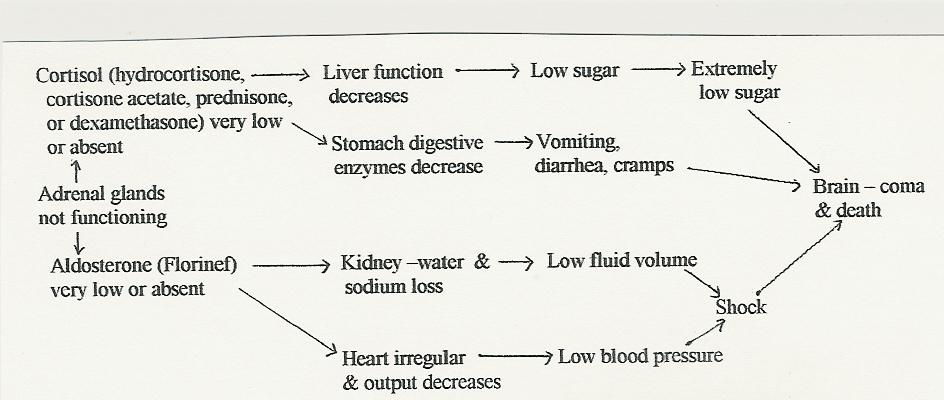
What You Must Know about Adrenal Crisis

I just found this page of VERY IMPORTANT information about adrenal crisis that Cushing's patients often face, either after pituitary surgery or after their adrenal glands are removed in a procedure called bilateral adrenalectomy, or BLA.

I am thankful to MaryO, the founder of Cushing's Help & Support.com and Cushie.com

This adrenal crisis page is a very informative for the patient, the caretakers, and emergency medical folks.  Many Cushies print this information and carry it along with their hydrocortisone and Solu-cortef (actovial) meds. They post the information on their refrigerators.

Be sure to read patient stories such as mom Jackie and daughter Sam's situation that went very, very wrong in Robin's post, Stars Go Blue. It brings tears to my eyes every time I read it.

This graphic from Sue explains it all, in a nutshell:

Tuesday, June 15, 2010

COOL DIAGRAM & DOCTORS SHARE WHAT THEY KNOW WITH PATIENTS

Hi everyone.

I have been doing a lot of research online, and I want to share some of my findings. With a disease this complex, there is always more to learn.

*******************************************

National Adrenal Disease Foundation has the best diagram that I have seen to explain the relationship between the pituitary and the adrenal glands.


*******************************************

The Swedish Neuroendocrine Institute's Pituitary Center in Seattle, Washington has held several conferences recently that are particularly important to pituitary patients. I applaud their efforts, and I am thrilled that they have posted videos of the conferences' presentations online. These very professional videos show the speaker at the podium in a smaller screen and the presentation up close, enabling us to read the "slides" as they present them. WOW--see the speaker and the screen! This makes my day!

It is also refreshing to finally listen in, like a fly on the wall, to many different physicians talking about a disease you have. We typically only see our ONE doctor about our disease. Seeing multiple doctors with in depth knowledge wraps the patients in warmth and comfort like a warm blanket. We need that.

While patients, family, and friends are obvious beneficiaries of these efforts, the real change in medical care will come when physicians see these videos. General practitioners, internal medicine, and ob/gyn doctors often see Cushing's patients first, and many don't realize what they are seeing.  Many patients walk first into their local doctors, who may only see an occasional pituitary patient, for help. Unfortunately, these local doctors are often confused about testing, diagnosis, and especially treatment plans, which is not too hard to understand since they only read about Cushing's in one "rare disease" chapter during medical school. Therefore, this online effort will give doctors a chance to learn from experts, and this will undoubtedly improve the road for pituitary patients.

I want to thank the SNIPC for sharing this helpful information with all of us.


A Patient's Road Map to the World of Pituitary Disorders, 2010.

Pituitary Symposium (Patient Presentations), 2009

Seattle Pituitary Center Patient Education Day, 2009

Physician Conference: Advances in Cushing's, 2009

You will find direct links to these presentations, as well as many important others, on this link.


*******************************************

That's all for now. See you next time.
~Melissa